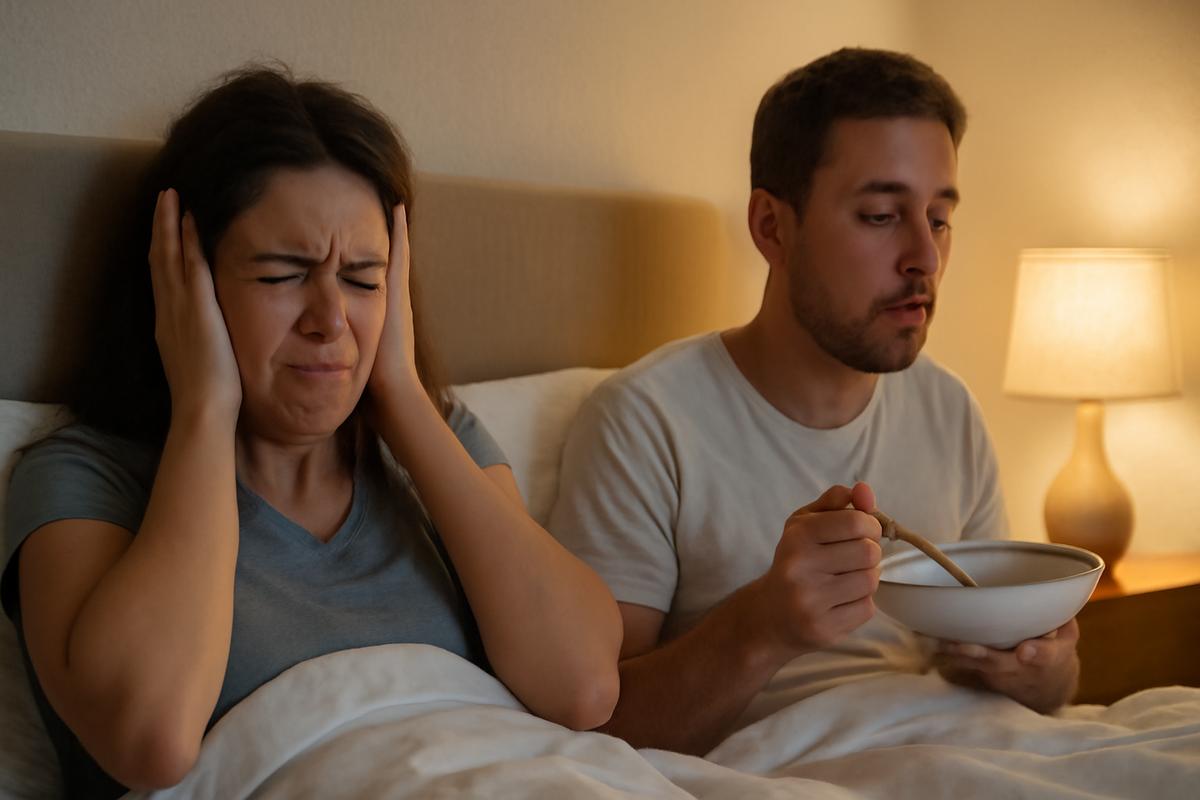
The sound starts as a small crack in the quiet—barely there at first. A wet click. A slow, rhythmic grind. You tell yourself you’re imagining it. You shift on the couch, tug the blanket up, turn the page of your book. But there it is again: the unmistakable, damp percussion of someone chewing. Loudly. Enthusiastically. Inescapably. And for some reason, right now, in the hush of night, it feels ten times louder than it did at lunch.
The strange physics of a quiet room
Night has a way of stretching sound, of magnifying the smallest noises until they feel like they’re pressing against the walls of your skull. The refrigerator hum sounds like a distant generator. The dog’s nails on the floor resemble tiny hammers. A spoon tapping the side of a bowl becomes an alarm bell.
But chewing is different. It’s not just sound; it’s presence. It’s a reminder that there’s another human body close—opening, closing, grinding, swallowing. At noon, over a busy café table or a clattering office kitchen, your brain barely registers the person next to you crunching on carrots. Yet at night, when the lights are low and the house is a soft container of shadows and whispers, that same crunch can feel like a personal attack.
Part of what’s happening is simple acoustics. During the day, the world is loud. Engines, voices, devices, wind, birds, traffic—these build a constant soundscape that your brain treats like a kind of audio wallpaper. Night pulls that wallpaper down. Outside sounds settle, and indoor noise takes over. The balance shifts from a crowded soundstage to a nearly empty one, and the few noises that remain step into the spotlight.
Chewing is especially easy to spotlight because it’s repetitive. Each bite is like a second hand on a clock you didn’t know was ticking until everything else went silent. Your brain starts following it. You can’t un-hear it. Now, with every wet smack or crunch, there’s a tiny spark of irritation that keeps flaring into something larger.
The brain that won’t stop listening
Inside your head, as the house settles for the night, your brain is actually ramping up in surprising ways. It’s not just you “being sensitive.” There are built-in, deeply human reasons why noises like chewing feel more intrusive after dark.
For most of human history, night was vulnerability time. Our ancestors huddled around fires, ears tuned for anything that sounded like danger: a twig snapping, leaves rustling, the distant pad of an unseen animal. Our nervous systems evolved in this world. They learned that nighttime quiet is not simply peace—it’s also a stage where the faintest sound might matter a great deal.
That ancient vigilance hasn’t vanished. Modern life tucks us indoors, behind locked doors and glowing screens, but our bodies still carry the old wiring. When the evening slows down and external demands fade, your nervous system shifts. The day’s adrenaline drip begins to taper. Your senses, especially hearing, often turn inward and outward at once—scanning the environment, measuring the silence.
Now add in the most human of all modern rituals: late-night snacking. Maybe it’s popcorn on the couch. Maybe it’s cereal at midnight, chips in bed, or leftover pizza eaten over the kitchen sink. You hear someone else’s chewing, and your brain—primed by a quiet house and an evolutionary habit of vigilance—locks onto it, treating the sound as meaningful. Not dangerous, exactly, but insistent. Important enough not to ignore.
And when your brain decides not to ignore something, it keeps returning to it, again and again, like a dog coming back to a single spot in the yard. That looping attention is what transforms “a sound” into “I can’t stand this anymore.”
The emotional storm behind a simple sound
Of course, not everyone has the same reaction. For some, loud chewing is a mild annoyance. For others, it’s a full-body jolt of anger or panic. You might feel your shoulders rising, jaw tightening, breath shortening. You’re not just annoyed—you’re enraged. Or trapped. Or desperate to escape the room.
This more intense reaction has a name: misophonia, often described as a strong emotional response to specific “trigger” sounds—chewing, breathing, tapping, lip-smacking, the click of a pen. It doesn’t show up as a simple dislike. It’s more like a rapid internal spike: fury, disgust, or anxiety that feels disproportionate to the situation.
Night amplifies all of this. During the day, you have distractions. You can move away, start a conversation, turn on music, leave the space. At night, your options shrink. The person making the sound is often someone close to you—a partner, sibling, roommate. You don’t want a fight over the crunch of cereal in a ceramic bowl, but the sound is burrowing under your skin.
This is where context becomes everything. Loud chewing at a crowded lunch spot is buffered by laughter, clatter, and visual distractions. You’re busy. Your brain has better things to do. But at night, especially in intimate spaces—bedrooms, small living rooms, cozy kitchens—the sound feels closer. There’s nowhere else to aim your attention. Emotion rides in on that narrow channel of sound and settles heavily in the room.
The quiet amplifies what you’re already feeling
The late hours tend to be when feelings we’ve successfully dodged all day circle back. Worries about work. Old arguments replayed. The vague melancholy of scrolling through other people’s lives online. Fatigue makes everything sharper and duller at once—your patience thinner, your reactions thicker.
Now picture this: you’re finally winding down. You’ve decided you deserve calm, stillness, maybe a bit of softness in the dark. You turn off the overhead lights. The room narrows to a pool of lamplight or the blue-white glow of a screen. Your mind starts trying to land, like a bird looking for a branch.
Then—chomp. Slurp. Chew. Repeat.
The sound doesn’t just interrupt the quiet; it interrupts your idea of what the night was supposed to be. You weren’t just asking for silence. You were asking for a small sanctuary from the day. Chewing barges in like an uninvited guest who opens your fridge and starts rummaging around.
So when you feel that spike of irritation, it’s not only about decibels. It’s about the gap between what you crave and what you’re getting. Your nervous system, frayed and tired, reads that gap as a kind of offense, however small. “Can’t I have just this one thing?” becomes the silent, simmering question behind your clenched jaw.
The science of stillness and sensitivity
There’s another layer to this: the way your body moves from wakefulness toward sleep.
In the evening, your brain starts to lean into slower rhythms. Melatonin rises, body temperature drops slightly, and the boundaries between “out there” and “in here” become a little blurry. You might find yourself more sensitive—not just emotionally, but physically. The tag in your shirt suddenly itches. A small draft under the door feels like a breeze. The faint sound of chewing—which you might have tuned out at 10 a.m.—pokes at your attention over and over.
As your brain prepares for sleep, it actually passes through stages where external stimuli feel more jarring. Imagine walking down a long hallway toward a dim room. In that hallway, every door you pass is cracked just enough for sound to slip through. You’re neither fully alert nor fully gone; you’re in that in-between place where the mind is no longer multitasking or racing, but not yet surrendered. Sounds in this liminal space often feel oddly huge.
On top of that, the auditory system doesn’t fully “turn off” while you’re falling asleep. It keeps monitoring the environment, comparing noises to a mental library of “normal” and “not normal.” A dripping faucet gets filed under “annoying but safe.” A plate shattering would jolt you upright. Loud chewing—especially if it has a wet, irregular, or unpredictable rhythm—sits in a strange middle category: familiar, but also invasive. Known, but not easy to ignore.
Underneath it all, your brain is processing your relationship with the person making the sound. If you already feel irritation, resentment, or emotional distance, the chewing noise might feel like a spotlight on all of that. If you feel safe and loved, the sound could still annoy you—but it may be easier to laugh off, to let it pass, to ask gently, “Hey, could we do snacks a little quieter?” without a storm behind the words.
How our senses stack up in the dark
During the day, sight rules. Your eyes feed you most of the information your brain uses to navigate. But as night falls, vision weakens, and other senses—especially hearing—step forward. Your ears do more of the environmental work. The result: sounds feel richer, more 3D, more textural.
Below is a simple comparison of how different sensory experiences often feel in the brightness of day versus the depth of night:
| Experience | Daytime | Nighttime |
|---|---|---|
| Background noise | Blended, constant, easy to ignore | Sparse, isolated sounds stand out |
| Chewing sounds | Masked by conversation and movement | Front and center, repetitive, intrusive |
| Emotional state | Distracted, task-focused, buffered | Tired, reflective, more vulnerable |
| Sense priority | Vision leads, sound competes | Hearing rises, sound dominates |
| Coping options | Move away, get busy, change environment | Fewer options, shared space feels smaller |
When you put these pieces together, the picture becomes clearer. Night doesn’t just dim the lights; it reshapes the entire sensory landscape, giving chewing—and other small, human sounds—a bigger stage than you ever signed up for.
When love meets loud snacks
There’s a tender, sometimes funny, sometimes painful reality underneath all of this: we usually notice nighttime chewing most in the people we live with. The ones brushing their teeth in the same sink, sharing the same bed, sitting on the same couch as the credits roll.
You might deeply love the person whose chewing makes you see red. That contrast can be confusing. How can the same mouth that whispers kind things or kisses your cheek also feel like a jackhammer in the dark when it meets a bowl of crunchy chips?
Part of the answer lives in intimacy itself. The closer someone is to you—physically and emotionally—the more their small habits become part of the fabric of your daily life. Repeated exposure can turn a minor irritation into a well-worn groove of annoyance. Night, with its fewer distractions and quieter backdrop, simply makes the groove more obvious.
There’s also the simple fact of shared timing. Evening is when couples and families tend to converge—after separate days of work, school, commutes, and obligations. You gather around a show, a game, a movie, a quiet conversation. Someone brings a snack. The sound begins. And because night is also when we’re unwinding, we’re less armored, less willing to tolerate those tiny frictions we might shrug off at noon.
Small rituals to protect the quiet
If you’re someone who feels that wave of irritation rise with every chew, you’re not helpless—and you’re not unreasonable. But the solution usually isn’t to demand perfect silence from everyone else. Instead, it can help to build small, compassionate rituals that protect your peace without turning the house into a battlefield.
A few gentle possibilities:
- Agree together that “crunchy foods” are for the kitchen, not the bedroom or couch at night.
- Keep a pair of soft earplugs or comfortable headphones near your reading nook or bedside.
- Turn on a low, steady sound—like a fan, soft music, or white noise—to give your brain something else to lean on.
- Have an honest, non-accusatory conversation in daylight: “At night I get really sensitive to chewing sounds. Could we come up with a plan together?”
- Practice noticing the first flicker of irritation and taking a slow breath before it explodes into a story: “They’re doing this on purpose. They don’t care about me.”
Sometimes, simply naming what’s happening—out loud, kindly—can mute its power. “My brain is in nighttime mode. Everything sounds extra loud.” That small acknowledgment can turn your reaction from a mysterious storm into a manageable weather pattern.
Listening differently in the dark
When you lie in a dim room and someone nearby begins to chew, you’re not just hearing them eat. You’re hearing your own history—your body’s old vigilance, your day’s leftover stress, your web of relationships—singing through that sound.
The night gives chewing a megaphone by stripping away the rest: the traffic, the chatter, the obligations. What’s left is you, another person, and the inescapable rhythm of a human mouth working through a late snack. That intimacy can feel grounding or grating, comforting or claustrophobic, depending on the moment.
If you find yourself bristling at the sound, it might help to remember that this sensitivity is, in some small way, proof that your nervous system is doing what it was designed to do: pay attention when the world quiets down. The goal isn’t to erase that instinct, but to live with it more gently—to add softness around the edges.
And maybe, sometimes, the answer is simply stepping out into the night for a moment: feeling the cool air, listening to the wind in the trees, the distant engine on a road you can’t see. Let the much larger sounds of the world remind you that the chewing, however maddening, is just one small noise in a very big, living dark.
FAQ
Why do I feel angrier about loud chewing at night than during the day?
At night, background noise is lower, your brain is more tired, and your senses—especially hearing—become more sensitive. With fewer distractions, your attention locks onto repetitive sounds like chewing, making them feel much more intense and irritating than they do in daytime.
Is it normal to feel extremely upset by chewing sounds?
Many people feel mildly annoyed, but if your reaction is very strong—rage, panic, or disgust—you may have traits of misophonia, a condition where specific sounds trigger powerful emotional responses. It’s not a character flaw; it’s a pattern in how your brain processes certain noises.
Why do I only notice my partner’s chewing and not other people’s?
You spend more quiet, intimate time with your partner, especially in the evening, when your sensitivity to sound is higher. Over time, repeated exposure can turn their chewing into a learned trigger, especially if there’s underlying stress or tension in the relationship.
Can anything make loud chewing less irritating at night?
Yes. Gentle background sounds (fans, soft music), using earplugs or headphones, setting “no crunchy snacks in bed or on the couch” rules, and talking honestly with the people you live with can all help. Managing your overall stress and sleep can also reduce how intensely you react.
Should I tell someone their chewing bothers me?
It can help, as long as you do it kindly and at a calm time—not in the middle of feeling triggered. Focus on your experience rather than their fault: “At night, I get really sensitive to chewing sounds. Could we figure out a way to make evenings easier for both of us?” This opens the door to cooperation instead of conflict.

Hello, I’m Mathew, and I write articles about useful Home Tricks: simple solutions, saving time and useful for every day.