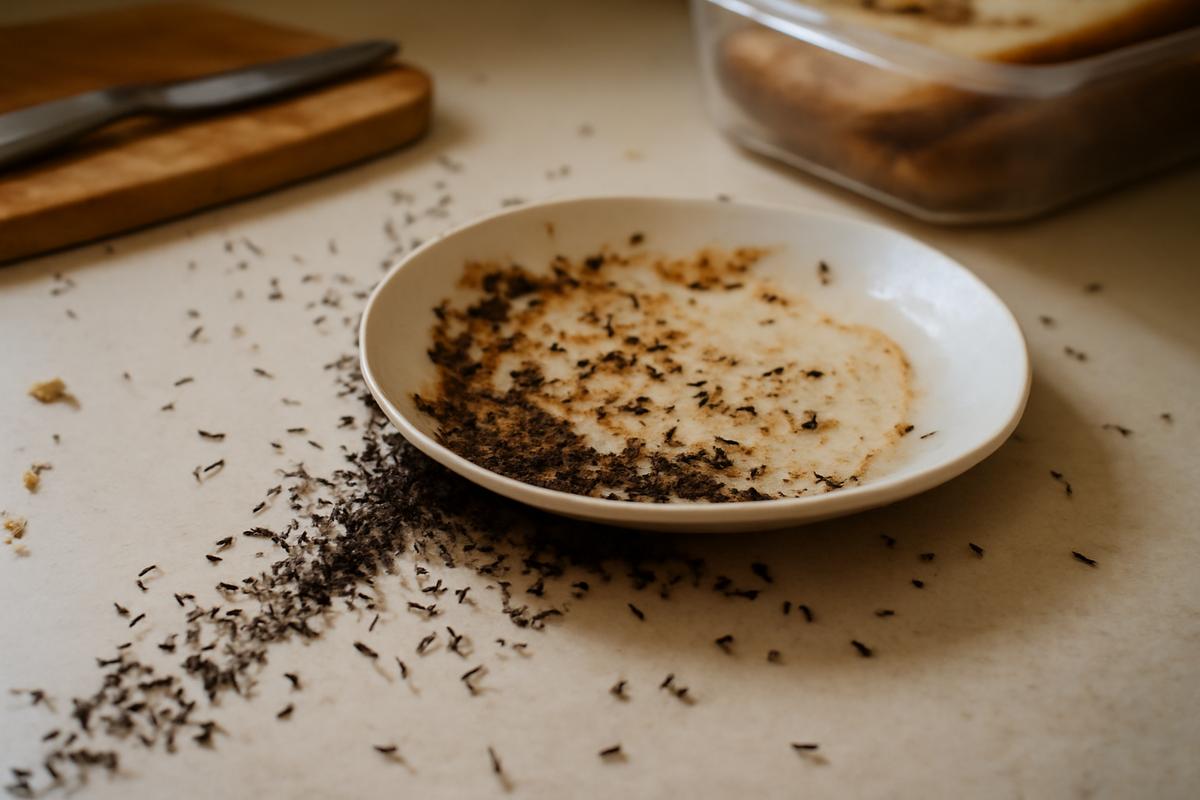
The first time it happened, it was sometime after midnight, in that blue hour when the house is quiet enough that you can hear the refrigerator hum like a distant engine. I padded into the kitchen barefoot, chasing a glass of water and a stray thought, and stopped short. The counter, which had been clean when I went to bed, was alive. A slender, glistening trail of ants threaded from the bottom of the window frame, across the backsplash, down to the very edge of the cutting board where I’d sliced fruit after dinner. I leaned closer. There it was: the sticky, half‑dried ring of juice from a single grape I’d dropped and lazily swiped toward the sink instead of actually rinsing.
The Quiet Invitation You Don’t Know You’re Sending
We like to imagine that ants appear out of nowhere, as if they materialize from some tiny portal in the baseboard purely to inconvenience us. But their story begins before we ever see them. Long before you catch that first stray ant scouting across the counter, your kitchen has already sent its invitation.
The invitation rarely looks like much. It might be that moment when you rearrange leftovers and a glossy streak of sauce stretches across the shelf. Or when you finish your nightly tea, rinse the mug with a lazy swirl, and set it upside down in the sink—leaving a film of sugar around the rim. The invisible smudge of jam on the knife you thought was “clean enough.” The teaspoon of honey that misses the mug and drips on the counter edge before you rush out the door. These are not messes, you tell yourself. They’re specks. Details. Life.
But to an ant, that tiny smear is a flare in the dark.
Ants don’t navigate the world the way we do. They are noses with legs. Their antennae, constantly tasting the air and the surface beneath them, can detect faint chemical traces we would never notice. Somewhere outside—under a rock, inside a rotting log, deep below the soil—one scout ant wanders, following scents like whispers. It slips through a gap in your window frame or a hairline crack along the floorboard and then… it finds it. Your almost-clean spoon, glistening with the microscopic sheen of sugar crystals.
That’s where the tiny habit comes in. It isn’t the big, obvious messes that reliably bring ants marching in overnight. Those, we tend to take care of. It’s the almost: the “I’ll rinse it later,” the “This is fine for now,” the “It’s just a little bit.” The small, ritual shortcut that leaves a sweet or greasy film somewhere in your kitchen, almost every evening.
The Tiny Habit: “I’ll Just Leave This for the Morning”
Ask a dozen people when ants are most likely to show up and you’ll hear about warm weather, summer picnics, a fresh spill of juice or soda. Those all help, sure. But the habit that actually turns your kitchen into an overnight ant festival is something far quieter: leaving food residue—especially sugary or oily—sitting out while you sleep.
Not full plates of food, not big spills. Just residue. The thin glaze of maple syrup on a plate stacked beside the sink instead of rinsed. The rim of a blender left unwashed after a smoothie. Crumbs swept into a casual pile on the counter and abandoned. An opened jar of honey with a sticky ring around the lid. We move on, the day ends, and the kitchen dims… but those small traces continue to glow in the chemical language of ants.
Night is when this habit truly shows itself. That’s when the scouts step out. While you’re sleeping, they roam in wider arcs, stretching their search patterns in places that feel safe from stomping feet and slamming doors. One of them will find your “good enough for now” spoon. She’ll taste it, turn, and walk back the way she came, laying down an invisible pheromone trail like a breadcrumb path. Within hours, you’ll have a procession.
The difference between a quiet, ant-free morning and the shock of seeing a moving line across your counter often comes down to those last five minutes before bed. Do you wipe the sticky ring? Rinse the plate? Swish water over the knife? Or do you flick off the light, promising you’ll handle it tomorrow?
The Invisible Feast on Your Counter
To understand why this habit is so powerful, imagine shrinking down and seeing your kitchen like an ant. Your eyes blur to vague shapes; your world becomes scent maps and microscopic textures. What you call “clean” is often something like a patchwork galaxy of scattered crystals, proteins, and oils. A streak of sugar dried thin on the counter is a buffet table. The faint smear of peanut butter on a knife handle becomes an entire grove of calories.
Here is where our idea of “dirty” and an ant’s idea of “useful” diverge. You might feel smugly satisfied after loading the dishwasher, tossing obvious trash, and giving the sink a casual splash with water. To ants, that same scene can look like this:
- A ring of dried soda where you set your glass down without a coaster.
- Crushed bread crumbs lodged between the stove and counter.
- A smudge of yogurt on the fridge handle from breakfast.
- A droplet of olive oil that overshot the pan.
They don’t need a spill you can see from across the room. They just need enough to make the trip worth it. Ant colonies operate with relentless efficiency; they will not spend energy where the reward is thin. But a kitchen where small, sweet, or greasy traces are left out night after night? That’s consistent income. The pheromone trail thickens. The habit of your household becomes the habit of theirs.
The Science Marching Across Your Floor
Ants are astonishing little strategists. A single worker ant can find a droplet of sugar solution diluted to fractions we wouldn’t taste at all. Their antennae can follow pheromone trails in tight zigzags, adjusting instinctively when the path gets faint. When scouts locate a good source, they don’t just recruit helpers; they compete chemically. Paths to richer sources get reinforced more strongly and more quickly.
This means that if you leave a sticky mug out once, you might just meet a handful of ants. But leave some form of residue out most nights—especially sugary ones—and those ants will essentially “vote” with their bodies. More ants walk the path, laying more pheromone, making the chemical highway stronger, until you wake one morning to find not a few, but a sheet of movement around the baseboards.
Over time, the colony learns your rhythms. Maybe you bake on weekends and spill a little vanilla extract every Saturday. Perhaps you always leave the cutting board with fruit juice traces overnight. The ants don’t know what a Saturday is, but they know pattern and payoff. They will shift their energy to where it matters most: that corner, that cabinet, that neglected space behind the breadbox where crumbs roll and disappear.
Put more simply: you are training them. Night after night, residue after residue, you are teaching a colony of ants that your kitchen is a reliable, low‑risk grocery store that opens after dark.
A Tiny Habit vs. a Tiny Army: What Actually Matters
So what do you do? Swear off sugar? Bleach every surface three times a day? Not necessary. The goal is not sterile perfection; it’s breaking the pattern that rewards the ants’ nightly explorations.
Surprisingly, the most powerful change is small and specific: respond to residue right away, especially after dinner and before bed. Not a full scrub, not a deep clean—just a deliberate, consistent ritual of erasing the invisible invitations.
Think of it as closing down a café at the end of the night. Chairs go up, lights dim, and a cloth glides over the bar, not because the bar was filthy, but because the day needs its period. So does your counter. When that last spoon of ice cream is eaten or that late‑night snack is finished, choose not to “just set it down.” Rinse it. Wipe it. A five‑second gesture that changes the story for an entire colony outside your walls.
| Common Night Habit | How Ants Experience It | Simple Swap |
|---|---|---|
| Leaving dessert plates near the sink “for morning” | Dried sugar film = rich food source all night | Quick rinse under hot water; stack in dishwasher |
| Half‑finished sweet drink on the counter | Concentrated sugary rim and puddle | Empty, rinse, and wipe ring with a damp cloth |
| Uncovered trash with food scraps | Easily accessible buffet with odor trail | Use a lidded bin and take out food waste regularly |
| Cutting fruit and leaving board until morning | Sticky juice and pulp in one convenient spot | Rinse and brief scrub, then stand board to dry |
| Open honey/jam jars with sticky rims | High‑sugar signal near pantry or counter edge | Wipe lids and threads; close fully after every use |
Learning to See Like an Ant
Once you know how little it takes to attract them, the kitchen starts to look different. You begin to notice things in the quiet moments: a faint glimmer on the tile that catches the morning light, the tiny crust at the edge of the honey jar, the pattern of crumbs beneath the toaster you slide aside once in a blue moon.
This isn’t about becoming paranoid; it’s about becoming attuned. There’s an unexpected intimacy in paying attention at that scale. You start to understand that your home is not sealed off from nature, but porous. Life is always looking for a foothold, especially the very small lives that thrive in our wake.
Watch what happens when you shift just one habit. For a week, decide that no sugary dish will spend the night with residue intact. Reluctantly, perhaps, you rinse the dessert bowls, run a cloth over the counter edges, and wipe the ring where a glass sat. At first, it feels like an extra chore tacked onto the end of a long day. But within a few nights, you might notice something quieter than the ants themselves: the absence of that first scout in the morning. The line along the baseboard breaks. The path to the recycling bin fades.
Sometimes we treat ant invasions like sudden storms: unpredictable, unlucky, an act of tiny gods. But most of the time, they’re more like weeds in a garden—predictable passengers of pattern and opportunity. Nature rarely wastes an open door.
The Emotional Weight of “Just a Little Mess”
There’s another, softer layer here, too, beyond biology and routine. The habit of “I’ll deal with it later” in the kitchen often mirrors the way we handle other things. The email that can wait. The conversation we’re not ready to have. The appointment we keep nudging forward in our calendar. Tiny postponements that feel weightless in the moment but quietly accumulate.
Ants, somehow, bring this into stark focus. There is something humbling, even a little embarrassing, about discovering a line of them marching toward that dish you were too tired to rinse. They are brutally honest auditors of our procrastination. They don’t care how hard your day was, how full your schedule is, or how reasonable your excuse might feel. They read only the evidence: sugar here, grease there, open trail between.
Changing the kitchen habit becomes, in a small way, an act of reclaiming your space and your time. When you run that final sponge over the counter and rinse the sweetness away, you’re not just evicting ants. You’re drawing a line between today and tomorrow. This day is complete, you’re saying. There is nothing here for the night to feed on.
Meeting Nature at the Threshold
There’s something oddly compassionate, too, about understanding why ants behave the way they do. They are not villains. They’re foragers doing exactly what evolution tuned them to do: find energy, bring it home, keep the colony alive. If anything, they are admirers of our excess, archivists of our crumbs.
When you stop leaving out that thin ribbon of honey or that un-rinsed dish, you’re not waging war so much as renegotiating boundaries. You’re sending a different message into their chemical world: not here, not this way. Food is kept closed, wiped, sealed. The trails they once reinforced begin to evaporate as fewer ants succeed in their forage. They turn their attention elsewhere, to the compost pile outside, the fallen fruit under the neighbor’s tree, the aphids on the rosebush—anywhere the world remains generous and unguarded.
In this sense, your kitchen becomes a kind of edge habitat, a threshold where human order and wild persistence meet. Each night, your tiny habit choice decides which side dominates by morning. A few extra seconds at the sink, and the valley of your countertops doesn’t become an overnight ant highway. Instead, the life that once streamed across your tiles remains where it arguably belongs more: in the soil, under stones, threaded through roots.
The story of the ants is not really about insects at all. It’s about noticing the chorus of small consequences that follows every small choice. In another light, that thin smear on a plate is like a sentence left unfinished, an invitation never rescinded. Wipe it away, and the story ends where you intended. Leave it, and a different cast of characters writes their own chapter while you sleep.
FAQs About Ants and Tiny Kitchen Habits
Why do ants show up overnight instead of during the day?
Ants often explore more boldly at night because the house is quieter and safer for them—less foot traffic, fewer vibrations, dimmer light. Your late‑night residue sits undisturbed for hours, giving scouts ample time to find it and recruit others before morning.
Is it really just sugar that attracts ants?
Sugar is a major magnet because it’s high-energy and easy to process, but ants are also attracted to fats, proteins, and even plain starch. Greasy pans, meat juices, and crumbs from bread or crackers can all be rewarding finds for a colony.
My kitchen looks clean. Why do I still have ants?
“Looks clean” at human scale can still mean “full of opportunity” at ant scale. Microscopic films of food, sticky jar rims, gaps around baseboards, and crumbs in hidden corners may not be visible but still emit scents and provide calories. Focus on wiping, rinsing, and sealing, not just tidying.
Do I have to deep clean every night to keep ants away?
No. The key is consistency with small actions: rinse dishes instead of leaving them with residue, wipe counters and table surfaces where food was prepared or eaten, close and wipe sticky containers, and keep trash covered. These targeted steps do more than occasional intense cleaning.
What if I’ve already got a full ant trail in my kitchen?
First, remove what they’re eating—clean the spill or residue thoroughly. Then, wipe along their trail with soapy water or a vinegar-and-water mix to disrupt the pheromone path. Seal entry points where possible and maintain your new “no overnight residue” habit. Without reward, the colony will gradually abandon that route.
Are ants a sign my home is dirty?
Not necessarily. Ants are opportunists and can appear even in generally clean homes, especially in warm seasons or during drought. However, regular small food traces and uncovered trash keep them coming back. Think of them less as a judgment and more as a reminder to close those tiny gaps in your routine.
Can one small habit change really make a difference?
Yes. Because ants rely heavily on consistent rewards to maintain their foraging routes, breaking that reward cycle with even a simple nightly ritual—like always rinsing dishes and wiping surfaces—can cause their trails to fade over days or weeks. A tiny change in your behavior can redirect an entire tiny army somewhere else.

Hello, I’m Mathew, and I write articles about useful Home Tricks: simple solutions, saving time and useful for every day.