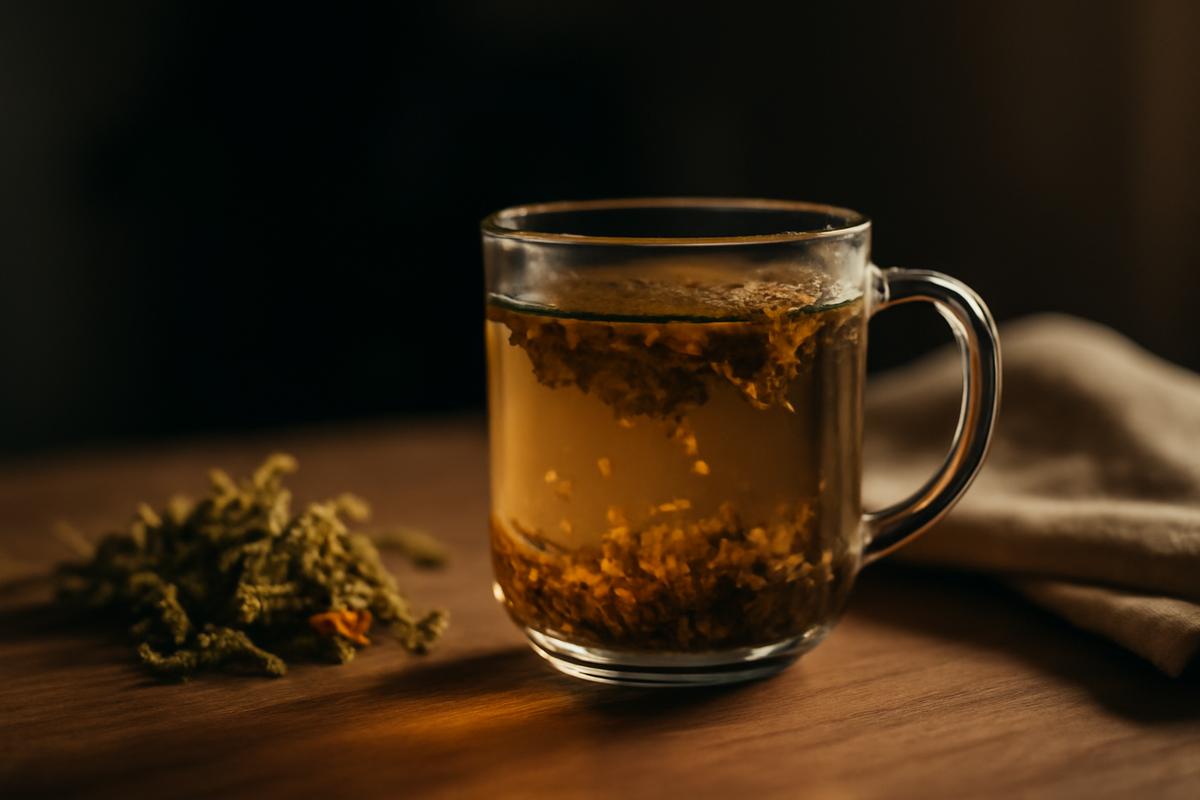
The kettle clicks off with a soft sigh, and for a brief, suspended moment, the world seems to exhale with it. Outside the window, the evening is folding itself into darkness—streetlights blooming in slow, amber halos, the last birds stitching their way across a fading strip of sky. Inside, you stand still and listen to something subtle and rare these days: the sound of almost-silence. Only the faint hum of the fridge, the rustle of fabric as you move, the whisper of hot water pouring over a spoonful of dried flowers and leaves. The steam rises, carrying a small, earthy promise: tonight, maybe, your nervous system will finally unclench.
A Night When Your Body Refuses to Power Down
Some nights, it’s like your body missed the memo that the day is over. Your brain keeps leafing through mental files: unfinished emails, strange comments from meetings, the way you snapped at someone you love, that one medical result you still haven’t checked. Your chest feels a touch too tight, your breath a bit too shallow. You’re tired, but not sleepy—wired and weary at the same time, like someone left every light on inside you.
These are the nights when scrolling doesn’t help, when one more episode feels like an assault, and even the idea of meditating seems like something that should come with an instruction manual. What you want is something simple, something you can hold, smell, taste. Something that tells your nervous system, in a language older than words, “You are safe now. You can soften.”
This is where a particular kind of nighttime tea steps forward—not the casual, distracted mug you sip while answering late messages, but a quietly intentional cup that almost behaves like a conversation with your own body. It’s a blend designed not just for sleep, but for the intricate web of nerves that has been tugged and frayed all day long.
The Botanicals That Speak in a Whisper
Herbalists sometimes talk about plants the way old friends talk about each other: calling out their tendencies, their gifts, their stubborn weaknesses. A calming night tea, the kind that gently modulates the nervous system instead of knocking you out cold, often centers on a few key plants that have been sitting in our collective story for centuries.
Chamomile: The Soft-Spoken Elder
Chamomile is often treated like a background character—something you sip from a paper cup in a waiting room. But when you meet good chamomile, full-bodied and golden, it’s like discovering that the quietest person in the room has the deepest stories. The scent is honeyed and apple-like, a little meadow in your hands. It’s long been used as a relaxing nervine, meaning it supports the nervous system when it’s tense, frazzled, or overstimulated.
Instead of knocking you over the head, chamomile works more like a hand on your shoulder: lowering the volume of the day’s anxieties, easing the body toward restfulness. It’s especially kind to people who “carry their worry in the gut”—those whose stress arrives as tightness, clenching, that vague unsettled feeling in the belly. A well-steeped chamomile tea can feel like a warm blanket laid gently across all that inner turbulence.
Lemon Balm: The Gentle Mood Lifter
Then there’s lemon balm, whose leaves release a bright, citrusy scent as if someone opened a window in a stuffy room. Where chamomile soothes, lemon balm nudges the mind toward lightness. Herbal traditions describe it as “gladdening” to the heart—a plant that helps smooth out jagged moods and dampens the edge of nervous excitement.
It’s particularly beloved for evenings when the mind spins with small worries and “what ifs,” not earthquakes but thousands of tiny tremors. Sipped slowly, lemon balm tea can feel like a recalibration; not sedation, but invitation. Your heartbeat feels a notch less insistent, your thoughts less sticky. The nervous system, teased all day by notifications and decisions, suddenly has a safe landing strip.
Passionflower and Valerian: The Quiet Gatekeepers
When nights tilt toward the more extreme—those nights when you’ve turned off the light three times and turned it back on just to check the time—two other plants often make an appearance: passionflower and valerian root.
Passionflower is for the tangled mind. Its traditional use centers on that “looping thought” state, when the nervous system is technically exhausted but refuses to disconnect. It doesn’t drug the mind so much as release it from its own repetitive grip, softening the edges of mental restlessness so the body can finally follow.
Valerian, by contrast, has a reputation like a blunt instrument: strong, earthy, almost pungent, both in scent and in effect. In many people it acts as a reliable sedative, especially helpful when muscles are drawn tight and the body seems to buzz from the inside. But valerian is also quirky—calming for many, oddly stimulating for some. It’s the plant equivalent of a powerful friend you only call when you really need them, and even then, you test the waters carefully.
The Ritual that Tells Your Nerves: “This is the Exit Ramp”
Of course, the plants alone are only half the story. The other half is what happens around them. The nervous system listens not just to chemicals and receptors, but to pattern and repetition. Over time, a simple tea ritual can become a kind of sensory lullaby your body recognizes long before the last sip.
You fill the kettle and listen for that low burble, the prelude to the whistle or click. You choose your mug—the chipped one with the memories, or the heavier one that feels grounding in your hands. You tear open a tea sachet or spoon loose herbs into an infuser, noticing colors and textures: pale straw petals of chamomile, dark knots of valerian, green flecks of lemon balm.
The hot water hits, releasing a small plume of aroma that’s part meadow, part forest floor, part subtle sweetness. Steam kisses your face. For the next few minutes, as the herbs steep and swirl, you don’t scroll; you wait. Waiting is its own kind of medicine. Your senses are gently reoccupied: the warmth against your palms, the small cloud rising from the mug, the quiet shifting of the liquid as you swirl it.
When you take the first sip, the flavor is a message all its own. Floral, slightly bitter, faintly sweet. A little wild. It’s not the slapped-in-your-face certainty of sugar, not the sharp crackle of caffeine. It’s something slower, asking you to meet it halfway. You swallow, and the warmth traces a path down your throat, spreading from your chest outward. You notice, maybe, that your shoulders drop a fraction of an inch. Your jaw unclenches. Your breath deepens, almost by accident.
In that moment, the tea is doing something quiet but profound: giving your nervous system a cue. This, it says, is the time when we turn down the dials. This is the exit ramp from the day’s highway.
Designing Your Own Night-Calming Blend
There’s a particular pleasure in making a tea that feels like it was composed for your body’s biography—its quirks, its fears, its signature tension points. While there are many pre-made “sleep teas” on shelves, crafting (or at least customizing) your own gives you a rare sense of collaboration with the plants themselves.
| Herb | Primary Feel | Nervous System Support |
|---|---|---|
| Chamomile | Soft, floral, honeyed | Eases tension, soothes gut-centered anxiety |
| Lemon Balm | Bright, lemony, uplifting | Calms nervous energy, lightens mood |
| Passionflower | Delicate, earthy | Quiets looping thoughts, supports deep rest |
| Valerian Root | Strong, earthy, musky | Deeper sedation for wired-tired states |
| Lavender | Floral, aromatic | Relaxes senses, eases nervous tension |
One simple starting blend for calming the nervous system at night might look like this, by proportion:
- 2 parts chamomile
- 2 parts lemon balm
- 1 part passionflower
- Optional: 0.5 part lavender flowers for aroma
Use about one heaping teaspoon of the mixture per cup of freshly boiled water. Cover the cup as it steeps—those rising aromatic compounds do much of the calming work, and you want them in your cup, not lost to the air. Let it sit for 8–10 minutes, then strain and sip.
If you’re the kind of person whose tension arrives like a full-body clamp, and gentle blends barely make a dent, you might cautiously introduce valerian root in very small amounts—starting with just a pinch, or blending it into pre-formulated teas so you’re not overdoing it. Always pay attention to how you feel the next morning: a good night tea should leave you restored, not fogged.
Over a week or two, you’ll start to recognize what ratio fits you. Maybe you increase the lemon balm because it lifts a low mood. Maybe you lean more heavily on chamomile because the day’s stress lives in your stomach. The tea becomes not just a beverage, but an evolving conversation with your own nervous system.
How the Body Hears “Calm” in Every Sip
When the warm liquid enters your body, it doesn’t follow a single, neat highway labeled “sleep.” It travels a whole constellation of routes—through taste, smell, memory, touch, the gut, the bloodstream. The calming effect is a mosaic, not a switch.
The very act of holding something warm can trigger a subtle parasympathetic response—the “rest and digest” branch of your nervous system. It’s the same reason a hot bath feels like a full-body exhale. Your heartbeat inches down. Blood vessels relax a fraction. The body registers, at a primal level: There is warmth here. We are not running.
Then there’s the scent, which has a direct line to parts of the brain involved in emotion and memory. The smell of chamomile or lavender can become, over time, a conditioned signal that it’s time to soften. Like a song you hear and instantly associate with a specific era of your life, your nervous system starts associating that aroma with winding down.
On a biochemical level, many calming herbs interact with the same nervous-system pathways that conventional anti-anxiety or sleep medications do, but more gently. Some influence GABA, a key neurotransmitter that naturally dampens neural excitement. Others ease muscle tension, soothe the digestive tract, or quiet palpitations that make the heart feel like it’s knocking on the inside of your ribs.
But the most underrated part may be the message beneath all this chemistry: You’re willing to spend ten quiet minutes tending to yourself. You chose not to battle your body, but to reassure it. For a nervous system braced against the day, that alone can be disarming.
When the Tea is Enough—and When It Isn’t
There will be nights when one mug, sipped slowly with the lights low, feels like a soft landing. The edges of worry blur; your limbs feel heavier; the pillow greets you like an old friend instead of an adversary. On those nights, you can almost feel the nervous system folding itself into rest, like a tent being taken down after a long, windy day.
There will also be nights when the tea is not enough. When anxiety barrels in with a sharper edge, or when chronic insomnia has rooted itself so deeply that herbs alone are like throwing petals at a locked door. In those seasons, the tea still has a place—less as a magic fix, more as a companion practice.
Think of it as part of a nightly constellation: dimmer screens, softer light, slower breathing, a cooler room, a conversation with someone you trust, or a journal page to lay the day down somewhere outside your head. The tea anchors the ritual, but it doesn’t have to carry the whole weight of your healing on its own.
And if your nervous system feels chronically frayed—if your heart races for no clear reason, if sleep evades you for weeks, if dread curls at the edges of your days—it’s wise to let a professional into the circle. A cup of calming tea can walk beside therapy, medical support, and broader lifestyle shifts. It doesn’t replace them; it reminds you, gently, that your body is still capable of responding to kindness.
Back at the kitchen counter, your mug now sits half-empty, the steam a faint ghost of what it was. Outside, the world has darkened fully; somewhere, a lone car passes, its headlights sweeping briefly across the wall. You feel it, that subtle recalibration, like someone quietly turned the dimmer knob on the inner noise. The tea hasn’t erased your problems. But it has softened the body that has to carry them.
In that softening, the nervous system loosens its grip on the day. Your shoulders sink a little deeper into your shirt. Your breath moves more slowly in and out through your nose. The thought of sleep no longer feels like a negotiation, but an inevitable tide slowly moving in.
Tonight, the tea is not a cure, or a trick, or a performance of wellness. It’s something older: a warm, fragrant offering to the overworked circuitry that keeps you alive. A reminder that your nerves are not just wires to be pushed to the limit, but sensitive instruments that sometimes need, more than anything, to be held in both hands and told, “You can rest now.”
FAQ: The Tea That Calms the Nervous System at Night
How long before bed should I drink a calming tea?
Most people find it helpful to drink their tea about 30–60 minutes before bed. That gives your body time to absorb the herbs while also letting the ritual itself signal to your nervous system that the day is winding down.
Can I drink calming tea every night?
For most people, yes. Gentle nervine herbs like chamomile and lemon balm are generally safe for regular nightly use. If you’re using stronger herbs like valerian long term, it’s best to check with a healthcare professional, especially if you take medications or have underlying conditions.
Will this tea make me groggy in the morning?
Milder blends focused on chamomile, lemon balm, and passionflower usually don’t cause morning grogginess. If you feel heavy or foggy after sleep, you may be using a blend that’s too strong for you, especially if it contains valerian. Adjust the proportions or lower the amount you use per cup.
Is calming tea safe if I’m on medication?
Some herbs can interact with medications, especially those affecting the nervous system, mood, blood pressure, or thyroid. If you’re taking prescription drugs or are pregnant or breastfeeding, talk with a healthcare provider or clinical herbalist before adding strong herbal blends to your nightly routine.
What if I don’t like the taste of herbal tea?
You can soften the flavor by blending gentler herbs (like chamomile and lemon balm), adding a little honey, or using a slice of fresh lemon. Another option is to start with smaller, weaker cups and gradually increase strength as you adjust to the taste. Often, as the tea becomes associated with relaxation, its flavor becomes more comforting over time.

Hello, I’m Mathew, and I write articles about useful Home Tricks: simple solutions, saving time and useful for every day.