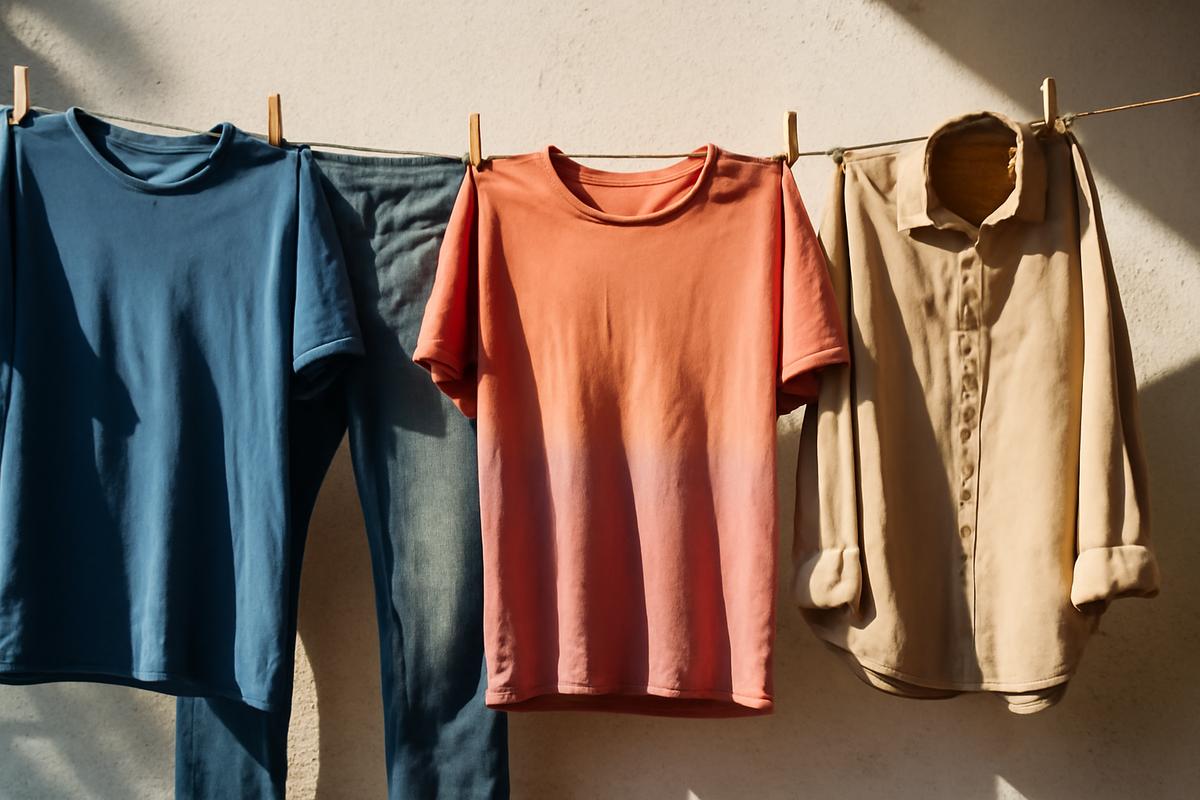
The first time you notice it, it’s almost nothing—a whisper of blue turned dusty, a once-vivid red that now looks tired around the seams. Maybe it’s your favorite T‑shirt hanging on the balcony rail, or the linen curtain that used to glow like warm sand. One hot afternoon you catch the light just right, and there it is: your clothes are fading, quietly, steadily, as if the sun is erasing them stroke by stroke. You shake them out, fold them, put them away, and that faint unease lingers. Where did the color go? And why does it feel like the sun has started eating through your wardrobe faster than ever?
The Secret Life of Sunlight on Fabric
Step outside on a clear day and you can feel sunlight as warmth on your skin, see it dancing off car windows, turning leaves into tiny green lanterns. But there’s a part of sunlight you can’t see or feel directly, and that’s the real culprit behind your fading clothes.
Sunlight is not a single thing—it’s a spectrum, a blend of different wavelengths, each with its own energy and personality. The visible rainbow you know—red, orange, yellow, green, blue, violet—is only a sliver. On one side there’s infrared, which you experience as heat. On the other side lives ultraviolet (UV) light, invisible and much more mischievous than its calm, glowing siblings.
UV light is like the rowdy guest at a gentle garden party: high energy, restless, always breaking things. That high energy is what makes UV rays so effective at causing sunburn on your skin, and it’s the same energy that slowly tears apart the colorful molecules in your clothes. When you leave a shirt draped over a chair by a sunny window for weeks, you’re basically offering it up to a slow-motion chemical storm.
If you’ve ever noticed that the side of your jeans that faces the window fades faster, or that black leggings turn a kind of dull charcoal after a summer of outdoor runs, you’re seeing UV radiation at work. It’s invisible vandalism: you don’t see the damage happening, only the aftermath.
Color Is More Fragile Than It Looks
Take a moment to think about what “color” really is. The deep cobalt of your favorite hoodie isn’t a property of the fabric itself so much as an illusion orchestrated by the way dye molecules play with light. Those molecules are tiny structures made of atoms bonded together in precise, delicate patterns. When light hits them, they absorb some wavelengths and reflect others—your brain interprets the reflected wavelengths as color.
But UV light, with its extra energy, doesn’t just bounce off. It barges in. It can break the chemical bonds that hold those dye molecules together, rearranging or shattering them so they no longer interact with light the same way. Once those molecular structures are broken, the colors they once produced begin to drift toward dullness: red veers toward pink, black grays out, blue goes vaguely ghostlike.
This process has a dramatic name: photodegradation—literally, “being broken down by light.” It’s the same reason posters in shop windows turn pastel, paintings need UV-protective glass, and magazines left in the car morph into washed-out versions of themselves. Your clothes are part of that same quiet transformation, only you’re more emotionally attached to them than to last month’s catalog.
Different dyes handle sunlight with varying degrees of stubbornness. Some are sunlight warriors, clinging to their hue after months outdoors. Others surrender easily. Natural dyes made from plants can be especially sensitive, though not always—indigo, for example, is famously tough. Synthetic dyes can be engineered for better lightfastness, but not all are. Sometimes the difference between a dress that keeps its color for years and one that fades within a season is simply the chemistry you never see printed on the label.
Why Some Fabrics Fade Faster Than Others
Color is only half the story; the fabric itself matters just as much. If dyes are the paint, then fibers are the canvas—and some canvases hold that paint more securely than others.
Imagine cotton: soft, breathable, familiar. Those cotton fibers are like tiny twisted ribbons of cellulose. They soak up dye quite well, but they also soak up water and can swell, stretching the dye molecules a bit farther apart. Add UV light, heat, and maybe a little sweat, and the dyes embedded in cotton can start to break down more quickly.
Then there’s linen, crisp and airy, spun from flax. It tends to be used in pale, natural tones, but when it is dyed, it can be quite vulnerable to sunlight. The same “summer-ready” qualities that make you love your linen shirt—its coolness, its lightness—also mean it’s often out in glaring sun for long hours, taking the full force of UV rays.
Synthetics like polyester and nylon are a different story. These are essentially plastics, long chains of petroleum-based molecules. Polyester often holds dye very tightly because the dye can literally sink into the fiber structure and lock there. That’s why many sports jerseys and swimsuits stay vivid after endless sun exposure. But synthetics can still fade—especially cheaper ones with lower-quality dyes or fabrics that have been repeatedly bleached or over-washed.
Then there’s a hybrid category: blends. That comfy T‑shirt might say “60% cotton, 40% polyester” on the tag. In practice, that means some of the fibers might hang on to dye better than others. Over time, the fading can look slightly uneven, almost like a soft mottling where one fiber type gives up color faster.
Fabric construction matters too. Tightly woven fabrics shield some dye from direct sunlight, while looser weaves expose more surface area. Think of a dense canvas tote bag versus a gauzy summer scarf: the scarf’s airy openness lets light weave through every thread, nibbling away at each fiber.
Sunlight Isn’t Working Alone
It would be convenient if you could blame fading on sunlight alone and walk away, but your clothes live a complicated life. Sun is just one of several forces conspiring, quietly and constantly, to steal their color.
Washing, for instance, is a surprisingly fierce accomplice. Detergents pull at dirt and oils, but they can also disrupt loosely held dye molecules. Hot water speeds up chemical reactions, including the slow unraveling of dyes. Frequent washing means frequent agitation—literally—of your fabrics and their colors.
Then there’s heat from dryers. That cozy blast can accelerate fiber aging. Combine this with residue from detergents, fabric softeners, sweat, and even skin oils, and you’ve got a reactive environment. Some particles act like tiny catalysts, making it easier for UV light to snap chemical bonds when the clothing eventually basks in sunlight.
Humidity also plays a role. Moist air lets molecules move more freely. Damp clothes hung in a sunny spot can actually fade faster: the combination of UV, moisture, and warmth becomes a mini chemistry lab humming in the background of your backyard or balcony.
And don’t forget air pollution. Tiny particles and pollutants in urban air can settle into fabrics; some of them interact with light to create free radicals—highly reactive chemical species that can attack dyes and fibers alike. It’s subtle and slow, but over seasons and years, it adds up.
Everyday Habits That Speed Up Fading
If you trace the path of your favorite shirt through an ordinary week, you can start to see why its color might be quietly draining away faster than you’d expect. Maybe you wash it after every wear, even if it only saw a few hours of use. Maybe you toss it into a hot wash by default because that’s what the dial was already set to. Then it gets thrown into the dryer on high, followed by a quick stint over the back of a patio chair or on a sunny windowsill “just to air out.”
Individually, these moments feel harmless. Together, they add up to a life lived on fast‑forward. Colors that might have taken years to mellow can start to lose their edge in just a season or two. Bright black jeans fade at the knees; a deep navy shirt becomes a quieter, less certain blue. You might even find that two identical items, bought at the same time, age differently simply because you treated one a little more gently than the other.
Your habits are not wrong; they’re just unexamined. And once you start to notice them, it’s hard to unsee the small, repeated choices that push your clothes closer to that familiar, washed-out look.
Why Sunlight Feels Harsher Today
Maybe you’ve had the sense that things fade faster these days—that a dress left on a drying line for a single afternoon comes back with just a hint less intensity, that car interiors bleach out in only a few summers. That impression isn’t entirely in your imagination.
UV levels at Earth’s surface can vary based on location, season, altitude, and atmospheric conditions. In some regions, changes in the ozone layer and shifts in climate patterns have allowed slightly more UV to reach the ground during certain times of year. While the differences might be small, your clothes experience them day after day, season after season.
Our lifestyles have shifted too. We live with larger windows, more glass balconies, more rooftop terraces. City apartments stack light-filled balconies on top of each other like open trays. Natural light is prized for mood and health—and rightly so—but that also means more textile surfaces are exposed to long, low angles of sunshine.
Even our wardrobes have changed. Fast fashion, cheaper dyes, and rapid production cycles often mean fewer resources devoted to high-performance, lightfast colors. Some garments are designed with an assumption of short-term use, not multi-year endurance. In other words, your clothes may be born slightly more fragile, even as they’re asked to withstand bolder, brighter lives.
Sunlight vs. Shade: A Small But Telling Difference
Think about two identical T‑shirts, both washed the same way, both worn every weekend. One is always dried outside in full sun, clipped to the line where the sky can flood it with UV. The other lives a shadier life, dried indoors on a rack or in diffuse light. After a year, line them up. Chances are, you’ll see the difference clearly: the outdoor shirt will be softer in color, its original shade gently sanded down by the day’s glare.
That visual contrast is more than just a laundry curiosity; it’s a quiet experiment you’ve run without realizing it. In your own backyard, your clothes are keeping time with the sun, marking the hours in slow shifts of pigment.
How to Keep Color Alive Longer
You can’t turn off the sun, and you probably wouldn’t want to. But you do have more influence than you think over how quickly your clothes surrender their color.
Small Choices with Big Impact
Start with where and how you dry your clothes. Direct sun is the most obvious accelerator of fading. Whenever you can, dry clothes in the shade or indoors near an open window where air can move but the sun doesn’t pour directly onto fabric. If you love line drying outside, turn brightly colored garments inside out; that way, the inner fabric takes the brunt of the rays, and the color you actually show the world is a little better protected.
Next, lower the temperature of your wash. Cool water is kinder to dyes and fibers alike. Modern detergents are designed to work well in cold cycles, which means you’re not losing much in terms of cleanliness, but you’re gaining longevity in color. Wash only when the garment actually needs it—spot clean where possible instead of reflexively tossing everything into the hamper after a single wear.
Be selective with detergents and additives. Harsh bleaches and brighteners can rough up dye molecules and leave fabrics more vulnerable to UV. If you must use these, reserve them for light-colored items or those meant to look deliberately faded. For your most cherished, rich-colored pieces, opt for gentler formulas labeled for darks or colors.
Your storage matters too. That sun-soaked chair near the big window might be the coziest place to drop a sweater, but hours of indirect sunlight can still nibble away at dye. Closets, drawers, or shaded hooks are quiet allies in the fight against fade.
A Quick Comparison of Fading Factors
Here’s a simple snapshot of how different parts of your clothing’s life influence fading:
| Factor | How It Speeds Fading | What You Can Do |
|---|---|---|
| Direct Sunlight (UV) | Breaks chemical bonds in dyes, bleaching color over time. | Dry in shade, turn clothes inside out, avoid long-term window exposure. |
| Washing Frequency | Agitation and detergents dislodge weakly bound dyes. | Wash less often, use gentle cycles, wash similar colors together. |
| Water Temperature | Hot water speeds dye breakdown and fiber wear. | Use cold or warm water, especially for dark or bright items. |
| Detergents & Bleaches | Chemical action can strip or weaken dyes. | Choose detergents for colors, limit bleach and strong brighteners. |
| Fabric & Dye Quality | Cheaper fibers and dyes degrade faster in light. | Invest in quality basics, look for “colorfast” or “UV-resistant” notes. |
None of these changes demand a radical new lifestyle. They’re more like quiet adjustments, small recalibrations of everyday rituals. Over time, they accumulate, not unlike fading itself—but in the opposite direction, toward preservation rather than loss.
Learning to See Fading Differently
There’s another way to look at all of this. Fading is, in a sense, a record. That soft, bleached-out band at the bottom of your curtain is a map of years of afternoon sun streaming in. The lighter shoulders of your denim jacket remember every walk, every day you forgot an umbrella and took the rain anyway. The gentle wash of color across your old T‑shirt is a tally of all the times you sat on warm picnic blankets and leaned against stone steps still holding the morning’s heat.
Once you understand why your clothes fade faster in sunlight, you face a choice: to fight that fading more deliberately or to accept some of it as part of the life of the garment. There is a kind of beauty in the slow softening of a once-bold color, the way a deep navy can transform into something like sea-glass blue—a story told very slowly, and only if you’re paying attention.
Knowing the science behind it doesn’t ruin the magic. If anything, it deepens it. That invisible UV light, those fragile dye molecules, the fibers twisting and relaxing with each wash—together, they turn your wardrobe into something living and changing, not static. You can protect your clothes more thoughtfully now, choosing when to spare them and when to let them collect a little sun as a memory.
The next time you pin a shirt to a line or drape a dress over a chair, you might pause, just for a heartbeat, and feel the weight of the light on the fabric. You might turn it inside out, or shift it into the shade. Or you might decide to leave it there, fully in the path of the afternoon sun, understanding exactly what you’re trading for that bright, wind-fluttered moment.
FAQ
Does only direct sunlight cause fading, or can indirect light do it too?
Indirect light can also cause fading, just more slowly. UV rays still bounce around in bright rooms, so clothes near windows, even out of the direct beam, can gradually lose color over time.
Why do black clothes seem to fade faster than lighter colors?
Black fabrics absorb more light, including UV, which accelerates photodegradation of the dyes. Because black relies on very intense, saturated color, even a small loss is more visible to the eye.
Are natural fibers better or worse than synthetics for resisting fading?
It depends on the combination of fiber and dye, but generally, many synthetics like polyester hold dye more tightly and resist fading better. Natural fibers such as cotton and linen can fade faster, especially with frequent sun and washing.
Can I reverse fading once it happens?
You can’t truly reverse photodegradation because the dye molecules have been chemically changed. However, you can sometimes refresh color with fabric dyes or color-restoring products, which add new pigment on top of the faded material.
Do UV-protective sprays for fabrics really work?
Some fabric-safe UV sprays can reduce the impact of sunlight by blocking or absorbing some UV rays before they reach the dyes. They don’t make fabrics immune to fading, but they can slow the process, especially on items that see a lot of sun, like outdoor cushions or curtains.
Is machine drying better or worse than sun drying for color?
In terms of color fading alone, moderate-heat machine drying in the dark is usually gentler than long exposure to strong sunlight. However, high dryer heat can still weaken fibers over time, so a balance—cooler settings, shorter cycles, or shaded air-drying—is ideal.
How can I tell if a new garment will fade quickly?
Clothing labels sometimes mention “colorfast” or “resistant to fading,” which is a good sign. You can also test a hidden seam by dabbing it with a damp white cloth; if color transfers easily, the dye may wash out or fade more quickly. Generally, very cheap, intensely colored items are more likely to lose color faster.

Hello, I’m Mathew, and I write articles about useful Home Tricks: simple solutions, saving time and useful for every day.