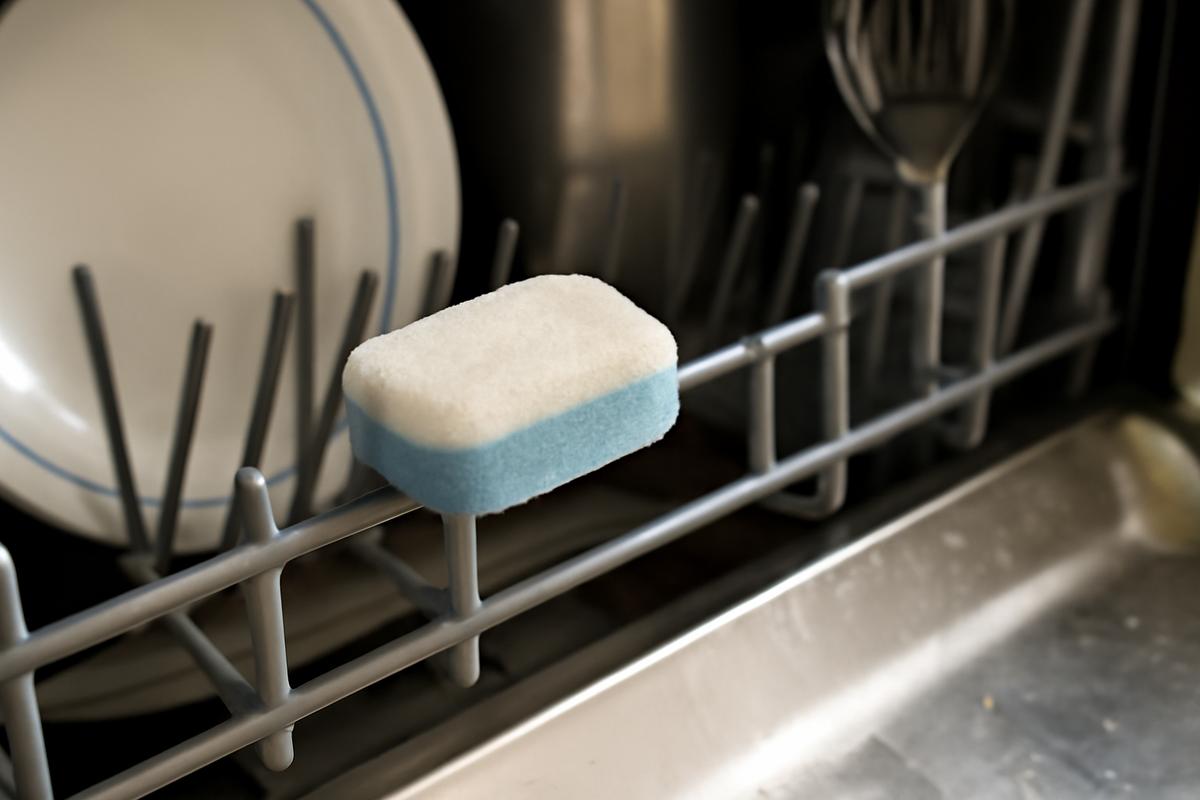
The first time you notice it, you think you’re imagining things. The dishwasher pings, the door swings open in a cloud of steam, and there it is: a ghostly crescent of half‑melted powder, stuck to the inside of the detergent flap or welded in a chalky crust to the cutlery basket. Your glasses are hazy, a fork has a bit of yesterday’s egg welded to it, and there’s that faint, almost metallic smell of “not quite clean.” You used the expensive tablets. You loaded everything “correctly.” So why, exactly, is your dishwasher tablet not fully dissolving—again?
The Slow Little Drama Inside Your Dishwasher
Every wash cycle is a tiny, contained weather system. Inside that closed metal box, water surges, steam rolls across steel and glass, and droplets race in chaotic paths down plates and bowls. The hum you hear from the next room is the sound of pumps and valves shuttling hot water through narrow channels and into spinning spray arms. Your dishwasher tablet is right at the center of this miniature climate—sitting in its dry little compartment, waiting for the cue to join the storm.
When things go right, the process feels invisible. The door opens, you’re greeted by a low, clean heat, and everything looks as if it’s been reset to “new.” The tablet compartment is empty. The only evidence it was ever there is the faint, chemically fresh scent and the way grease has simply…vanished.
But when things go wrong, the evidence is stubborn and literal. A blue and white lump caught halfway between solid and slush. A gritty residue at the bottom of the machine. Plastic containers with a greasy sheen on the inside. It’s not just annoying, it feels vaguely unfair. You did your part; why can’t the tablet do its job?
The answer is that your dishwasher is less of a magical black box and more of an ecosystem: water pressure, temperature, chemistry, timing, and even the way you toss in that oversized pasta dish all conspire—for or against that dissolving tablet. Understanding that quiet little drama inside the machine is the key to finally banishing those half‑melted stowaways.
The Chemistry of a Tablet That Never Got Its Moment
Before blaming the dishwasher, it helps to understand the tablet itself. It’s easy to think of it as a fancy block of “soap,” but modern tablets are more like compressed chemistry sets. Inside that neat little brick are surfactants to break down grease, enzymes to chew through proteins and starches, oxygen‑based bleaches to de‑stain, and water‑softening agents to keep minerals from clouding your glassware.
All of this is bound together under pressure in a way that’s supposed to be both tough and fragile: sturdy enough to survive being handled, dropped, shipped, and rattled around your cupboard—but fragile enough to fall apart completely when hit with hot, surging water at just the right moment. Many tablets are wrapped in a polyvinyl alcohol (PVA) film that’s designed to dissolve when it meets water, like tissue paper exposed to rain.
Now imagine that tablet staying mostly dry for the first ten or fifteen minutes of the cycle. The door compartment never fully opens because a pan is blocking it, or the spray arms can’t reach it with enough pressure, or the water is only lukewarm. The fragile film softens but never quite disappears. The powder inside clumps, absorbing tiny amounts of moisture and forming a dense, chalk‑like core. By the time hotter water arrives, the critical moment has passed. The enzymes should have been sloshing around early in the wash, tackling food soils; instead, they’re huddled in a sticky pellet stuck to the dispenser door.
What you’re seeing when the cycle ends is not just an aesthetic failure; it’s a timeline gone wrong. Your machine did something, the tablet tried to respond, and they missed each other by just enough seconds—and just enough degrees—to leave you with dishes that feel “almost” clean.
1. The Quiet Sabotage of a Blocked Dispenser
Open your dishwasher door and look at where the detergent compartment sits. It’s usually on the inside of the door, low and central, in what seems like a uselessly specific spot. It’s there for a reason: when the compartment door flips open mid‑cycle, it needs clear air and water to flood the tablet, dissolving it quickly and throwing those ingredients into the wild swirl.
But your dishes rarely arrive arranged like a minimalistic showroom. There’s last night’s baking tray leaning casually against the lower rack. A pasta pot wedged upright. Oversized dinner plates pressed close to the door. Maybe a big plastic chopping board is leaning outward like a shield. To you, it’s just “making things fit.” To your detergent compartment, it’s a barricade.
If something is pressed against or directly in front of the dispenser, the door can either fail to open fully or open into a tight little cave where only a trickle of water can reach. The tablet falls into this pocket of shadow, and while the rest of the dishwasher is frothing with motion, your detergent is sitting in what might as well be a dry alcove, half protected from the storm.
By the time the water finally reaches it in any serious way, part of the cycle is already spent. The result: a half‑used tablet, a chalky streak of detergent stuck to the door, and you wondering if the product is defective when, really, it’s your casserole dish playing the villain.
2. When “Eco” Means “Not Hot Enough”
Modern dishwashers are more efficient than ever, and they achieve that often by dialing back heat. Eco or quick‑wash cycles can be seductive: they sound green, they finish faster, and they seem perfectly logical for “lightly soiled” loads. But your tablet’s chemistry was designed with a certain temperature profile in mind.
Enzymes that break down proteins and starches come alive in warm water—but not cold. Bleaching agents and some binders dissolve more completely at higher temperatures. If your water never really gets past “warm bath,” the tablet can soften without ever fully letting go of its tightly bound ingredients.
Sometimes you’ll see the result as a chalky, undissolved layer clinging to the dispenser. Other times it ends up as gritty residue along the filter or grates—evidence that the tablet dissolved partially, but too late and too unevenly, never fully activating at the moment when food soils were easiest to attack.
Eco cycles also tend to use less water. Less water means less spray force. Less force means fewer chances for the tablet to be hammered by the jets that are supposed to break it apart. The cycle that makes you feel virtuous on an energy chart might be quietly sabotaging your detergent performance.
3. Pressure, Arms, and the “Rainstorm” That Never Quite Forms
Bring your focus to the spray arms themselves—those long, perforated wands that spin like slow propellers under and sometimes above the racks. They don’t just sprinkle water; they choreograph it. The pressure, direction, and reach of that water are what make the difference between a tablet dissolving into a fine mist of chemistry and a tablet sulking in a corner, only partly eroded.
Over time, the tiny holes along the spray arms can clog. Mineral deposits, bits of food, paper labels from jars, stray seeds or grains—they all contribute. The change is often gradual, so you don’t notice it until the pattern of water has shifted just enough that whole corners of the machine are less soaked, less forceful, less alive.
When those spray arms are partly blocked, water still moves, but the character of the storm changes. Instead of sharp, directed jets slamming into the detergent compartment, you might only have a few thin streams glancing past it. The arm might spin more lazily. A tablet that once would have been shattered into solution now just slumps as the outer layers give way, leaving a stubborn core.
There’s something almost eerie about it: the cycle still sounds normal from the outside, but inside, the architecture of the wash has altered. The rainstorm that tablet depended on simply never arrives with the same intensity, and you’re left with a polite drizzle where there should have been a monsoon.
4. Hard Water, Soft Tablets, and Invisible Minerals
Water is never just water. In many homes, it arrives laced with dissolved minerals—calcium, magnesium, iron—that turn into the white film on your glasses and the tight, squeaky feel on freshly washed hands. That same hardness doesn’t just cloud your glassware; it changes how detergents behave.
In hard water, detergent ingredients must work overtime. Instead of focusing on food and grease, part of the tablet’s chemistry is “spent” just trying to neutralize minerals. The water can feel physically different as it churns: less eager to carry dissolved substances, a bit more stubborn about letting things go fully into solution.
Some tablets are designed with built‑in water‑softening agents. But if your water is very hard and you’re not using additional dishwasher salt (in machines that have a softener system), the deck is stacked against proper dissolving. The tablet might still disintegrate, but more slowly, in clumps, shedding gritty fragments rather than disappearing in a rush of cloudy water.
Over time, mineral scaling inside the machine adds another layer of resistance—on spray arms, heating elements, and sensors. It’s like plaque in the arteries of your dishwasher: invisible at first, quietly affecting flow and heat transfer long before you realize something is off.
5. Age, Storage, and the Slow Creep of Damp
Dishwasher tablets have a kind of quiet vulnerability. They look solid, even bulletproof, but inside their compressed blocks, the ingredients are sensitive to time and air. Exposure to humidity—the kind that seeps into cupboards near sinks, or lingers in a just‑run kitchen—can slowly pre‑activate them.
A tablet stored for months in a half‑open bag can harden or clump, its fine powders fusing together, its soluble outer layers compromised. Sometimes the PVA film becomes brittle; other times, it wrinkles and adheres more tightly to the tablet’s surface. Either way, what goes into the dispenser is no longer exactly what the manufacturer designed.
When that slightly aged tablet meets water, it doesn’t crumble the way it should. It softens, but the interior remains dense, almost stone‑like. The machine can struggle to melt through this compacted heart in a single cycle, especially if you’re using cooler, shorter programs. At the end, you’re left with that lozenge of wasted potential, stuck like a fossil on the inside of the door.
A Quick Glance at What’s Going Wrong
Here’s a simple way to map the most common culprits and how they show up after a cycle. If you recognize your dishwasher’s “symptoms” in this table, you’re already halfway to a solution.
| Visible problem after wash | Likely cause | What to check first |
|---|---|---|
| Tablet still in dispenser, almost intact | Blocked dispenser door or very low spray pressure | Large items near door; clogged spray arm holes |
| Tablet half‑dissolved, stuck to door in a paste | Water too cool, short cycle, or tablet old/damp | Try a hotter cycle; use a fresh tablet; check water heater setting |
| Gritty white residue on bottom/filter | Hard water or incomplete dissolving late in cycle | Check water hardness, add salt if applicable, run a hot intensive wash |
| Cloudy glasses and greasy plates, but no tablet visible | Tablet dissolved too late or in low volume of water | Avoid overloading; ensure spray arms spin freely; avoid “quick” for dirty loads |
Rewriting the Script: Small Changes, Big Difference
Standing in front of your open dishwasher, you have more power than it may seem. The fate of that tablet is shaped in the few minutes you spend loading and choosing a program. A handful of small tweaks can turn the whole performance around, so that the tablet doesn’t just “sort of” disappear, but dissolves completely—at the right time, in the right way.
Start with spacing. Think of the detergent compartment as a small stage that needs a clear line of sight to the audience of water jets. Pull back that baking tray a little. Angle that cutting board so it leans to the side instead of straight across the door. Leave a visible gap around the compartment; if you can’t clearly see its outline when the machine is loaded, your tablet may not see much water, either.
Then, spin the spray arms with your hand. They should move freely, without bumping into tall items. If something is stopping their rotation, it’s robbing the machine of the dynamic movement that helps tear the tablet apart and sweep its ingredients into every corner. A blocked arm is like a broken wing in this closed ecosystem; the storm becomes lopsided, and the tablet is one of the first victims.
As for temperature, give your machine a fighting chance. For heavily soiled or full loads, skip the quick or eco programs now and then and run a hotter, standard or intensive cycle. If your home has a separate water heater, check its setting—if it’s set very low, your dishwasher may never quite reach the heat levels its designers expected. The goal isn’t scalding, but warm enough for enzymes and bleaches to truly wake up.
Your habits outside the machine matter, too: keep tablets in a sealed container, away from damp air. If a pack has been sitting open under the sink for months, consider that some of those stubborn half‑dissolves might be the quiet consequence of slow moisture creep, not only mechanical failure.
Listening to the Machine’s “Body Language”
Every dishwasher has a kind of personality. Some roar; others purr. Some use vigorous, rapid sprays; others rely on slower, soaking passes. Once you start paying attention to what comes out at the end of each cycle, you begin to sense patterns: this setting always leaves the tablet a bit pasty, that one never does; this particular way of stacking plates seems to cause trouble more than others.
There’s a strangely satisfying intimacy in learning your machine this way. You start to decode its body language: the hollow thump of the dispenser door opening mid‑cycle, the length of quiet pauses between loud spray bursts, the way steam rolls out when you crack the door right after it finishes. If you open it immediately after that first loud phase, you may even find trace evidence of the tablet already starting to break apart—or not, if something is amiss.
Try a small experiment: run a cycle with the machine empty except for a single tablet in the compartment. Choose a hotter program. When it finishes, open the door and study what’s left. If the compartment is spotless and there’s no trace of undissolved material, your tablet and machine know how to dance together in theory. If you see lingering chunks even in an empty run, the issue may be deeper: a faulty dispenser door, a failing heating element, or severely clogged spray arms.
This kind of simple, observational testing tells you whether the problem lies mostly in loading habits and cycles, or in the hardware itself. It moves you from vague frustration—“Why won’t this thing work?”—to a grounded, almost investigative curiosity about what, precisely, isn’t lining up.
The Small Satisfaction of a Fully Vanished Tablet
On the surface, this is a story about soap that doesn’t disappear. But underneath, it’s about the quiet web of causes that shape everyday life in our kitchens. The dishwasher sits there, hummingly loyal, taking in our mess and returning clean order, cycle after cycle. When a tablet doesn’t fully dissolve, the spell is broken, and we’re suddenly forced to see the machine’s inner workings.
Once you learn those workings—how water, heat, pressure, chemistry, and placement all interplay—that chalky remnant stops feeling like an insult and starts feeling like a clue. You experiment a little, make room around the dispenser, clean the spray arms, adjust a program. Slowly, the pattern changes. The next time you open the door and the compartment is bare, its surfaces rinsed clean, no powder caked in a corner, you feel an oddly disproportionate sense of victory. The system has aligned. The weather inside the box has turned in your favor.
And maybe the next time someone in your house grumbles about “those useless tablets” or “this old dishwasher,” you’ll find yourself telling a quiet little story: about blocked doors and lazy spray, about enzymes that need warmth, about tablets that age like bread left open. A story about how even in the most ordinary chores, there’s a hidden choreography—one you can learn to read, and even, in small but satisfying ways, to direct.
FAQ
Why is my dishwasher tablet still in the compartment after a full cycle?
Most often, something is blocking the dispenser door or the spray arms can’t reach it with enough force. Large plates, baking trays, or cutting boards can stop the door from opening fully. Try leaving a clear space around the compartment and make sure the spray arms can spin freely.
Do eco or quick cycles cause tablets not to dissolve properly?
They can. Eco and quick cycles usually use cooler water and less of it. That can mean the tablet doesn’t fully dissolve or dissolves too late. For full or dirty loads, using a standard or hotter program helps tablets work as designed.
Can old or damp dishwasher tablets cause residue?
Yes. Tablets that have absorbed moisture can harden or clump inside, making them dissolve more slowly or unevenly. Store them in an airtight container in a dry place and avoid using very old or obviously clumped tablets.
How does hard water affect tablet dissolving?
Hard water is rich in minerals that compete with detergent ingredients. Tablets may dissolve more slowly and leave white, gritty residue. If your machine has a salt compartment, keeping it filled and sometimes using a rinse aid can improve performance.
Should I put the tablet in the cutlery basket instead of the dispenser?
It’s usually best to use the dispenser, because it controls when the tablet is released. Putting the tablet in the basket can cause it to dissolve too early or too quickly. Only try the basket as a temporary test if you suspect the dispenser mechanism itself is faulty.
Why are my dishes still dirty even when the tablet seems to dissolve?
If the tablet dissolves, but dishes are still dirty, the ingredients may be released too late in the cycle, or water isn’t reaching all areas. Check loading patterns, clean the filters and spray arms, and avoid overpacking the racks.
How often should I clean my dishwasher to help tablets work properly?
A light clean once a month—filters, spray arms, and door seals—is usually enough for average use. Running an occasional hot cycle with a dedicated machine cleaner or a cup of plain dishwasher‑safe cleaning solution can also help keep internal parts free of buildup so tablets can fully dissolve.

Hello, I’m Mathew, and I write articles about useful Home Tricks: simple solutions, saving time and useful for every day.