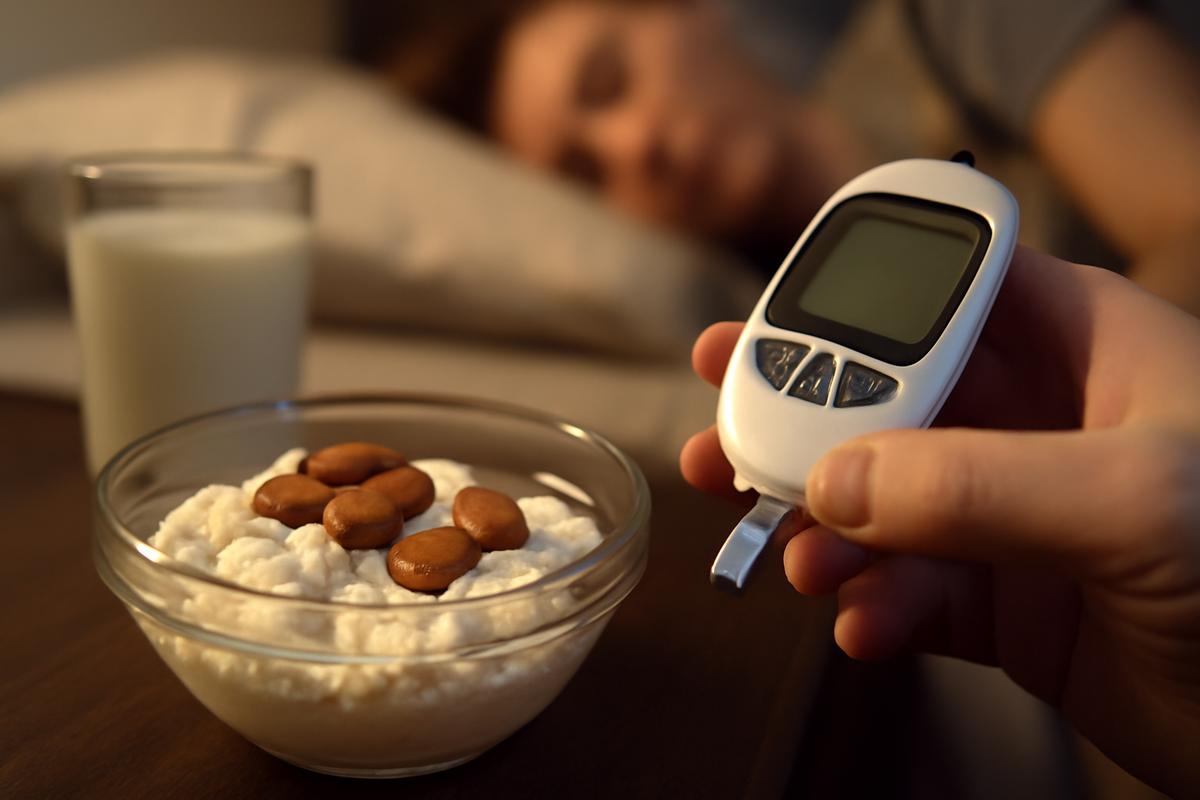
The first time I heard someone call it “the moon snack,” I laughed. It sounded like something from a children’s story, a tiny ritual you’d perform under a silver sky to keep the night gentle. But the woman who told me about it wasn’t joking. She was exhausted, eyes soft with that specific kind of tired you earn from years of troubled sleep and blood sugar swings. “It’s the only thing that lets me sleep through,” she said, palms wrapped around a mug of chamomile tea. “A small, steady snack before bed. Not a treat. Not a feast. Just a quiet promise to my blood sugar that the night will be calm.”
The Quiet Chaos Happening While You Sleep
Most of us think of sleep as a kind of off switch: you lie down, close your eyes, and your body powers down like a phone on airplane mode. But inside, especially if you struggle with blood sugar issues, it’s more like a dimly lit control room full of blinking lights and low conversations. Hormones rise and fall. The liver releases glucose. Insulin whispers through the bloodstream, trying to keep peace. And if the whole system is even a little unstable, your night can turn into a quiet storm.
If you’ve ever jolted awake at 3 a.m. with your heart racing, skin damp, brain suddenly electric with useless thoughts, you might have already met this storm. Maybe you blamed stress or a bad dream. Maybe you stared at the ceiling, wondering why sleep felt like something you had to fight for. For many people, especially those with diabetes, insulin resistance, prediabetes, or reactive hypoglycemia, those early-morning awakenings can be a sign that blood sugar isn’t as steady as it pretends to be.
Here’s what often happens: you have dinner, maybe a dessert, and your blood sugar rises. Insulin steps in to bring it back down. Hours later, especially if dinner was early, your blood sugar can dip a little too low during the night. Your body, protective and ancient, interprets this as a threat. It sends out stress hormones like cortisol and adrenaline to rescue you by nudging blood sugar back up. Those hormones don’t just raise glucose—they also raise your heart rate, wake your mind, and leave you lying there, wired and confused in the dark.
This is where the idea of a bedtime snack turns from “childhood habit” to “gentle tool.” Done wrong, it’s just another blood sugar rollercoaster. Done right, it becomes something else entirely: a way of smoothing the metabolic waves that crash against your sleep.
The Bedtime Snack That Behaves Like a Gentle Anchor
Let’s be honest: the phrase “bedtime snack” doesn’t exactly sound healthy. It smells like ice cream on the couch, chips in bed, crumbs on the pillow. But the kind of snack that helps stabilize blood sugar is different. It’s less about indulgence and more about chemistry and rhythm—a little anchor you drop into your bloodstream so it doesn’t drift during the night.
If you imagine your blood sugar as a small boat on a dark lake, what you want before bed is something that keeps that boat from swinging wildly when the night winds pick up. That “something” turns out to be a specific combination of three things: protein, healthy fat, and slow, fiber-rich carbohydrates.
Protein and fat are the quiet guardians of the night. They digest slowly, releasing their energy like a dimmer switch instead of a flashbulb. They help you avoid sharp spikes and plunges, so you’re less likely to provoke that panicked hormone response at 2 or 3 a.m. Meanwhile, a small amount of complex carbohydrate gives your body just enough accessible fuel to keep the engine humming along without draining the tank.
It’s the balance that matters. Too much carb—and especially the quick, refined kind—can rocket your blood sugar up right before bed and send you into the very rollercoaster you’re trying to avoid. Too little carb, and you might not give your body the fuel it needs to glide through eight hours without dipping. You’re looking for calm, not excitement; a tide that rises slowly and ebbs even more slowly.
The Goldilocks Snack Formula
Most people do well with a snack that contains roughly 10–20 grams of protein, a small serving of healthy fat, and 10–15 grams of slow-digesting carbohydrate. It’s not a rule carved in stone—bodies are individuals, after all—but it’s a gentle starting place.
Think of it like this: enough to whisper to your metabolism, “You’re safe. You’ll be fed. There’s no need to sound any alarms tonight.”
What This Snack Looks Like in Real Life
It’s one thing to talk theory; it’s another to stand in your kitchen at 9:30 p.m., fridge light glowing, and try to make sense of it. The best bedtime snack doesn’t need to be fancy. In fact, it’s better if it isn’t. Our bodies crave rhythm and familiarity. A simple, repeatable ritual signals safety.
Close your eyes for a moment and picture this: the soft clink of a spoon against a ceramic bowl, the quiet rustle of a jar lid turning, the cool, tangy smell of plain Greek yogurt rising into the air. You swirl in a spoonful of almond butter, its roasted aroma warm and nutty, and top the surface with a small handful of berries—raspberries, maybe, their brightness cutting through the richness. It’s not dessert in the traditional sense, but it feels like a small ceremony, a peaceful one.
That bowl is doing more than comforting you. The yogurt brings protein and a gentle tang. The almond butter adds fat and a bit more protein, slowing digestion. The berries contribute color, a touch of sweetness, and fiber, nudging the whole thing into “slow release” territory instead of “sugar rush.”
Here are a few examples of bedtime snacks that often work well for blood sugar stability, especially when you’re deliberate about portion size:
| Snack Idea | Why It Helps | Approximate Balance |
|---|---|---|
| Plain Greek yogurt (¾ cup) + 1 tbsp nut butter + a few berries | Protein and fat slow digestion; berries add gentle fiber and natural sweetness. | High protein, moderate fat, low–moderate carbs |
| Cottage cheese (½–¾ cup) + ½ small apple or pear slices + sprinkle of cinnamon | Casein protein digests slowly; fruit adds a controlled carbohydrate source. | Moderate protein, low fat, moderate carbs |
| Small handful of nuts (about 10–15) + one or two whole-grain crackers | Nuts provide fat and protein; crackers offer just enough slow carbs. | Moderate fat, moderate protein, low carbs |
| Hard-boiled egg + a few carrot sticks or cucumber slices | Very stable: protein and fat with minimal carbohydrate, good for those very sensitive to carbs. | High protein, moderate fat, very low carbs |
| Half a small banana + 1 tbsp peanut butter | Classic pairing: carbs from banana softened by fat and protein from peanut butter. | Moderate carbs, moderate fat, moderate protein |
Notice how none of these are huge. They’re not second dinners. They’re small, deliberate, and gentle—the metabolic equivalent of a weighted blanket.
When a Bedtime Snack Becomes a Sleep Story
The power of this nighttime snack isn’t just physiological; it’s also deeply psychological. A consistent ritual at the same time each night teaches your nervous system what’s coming. Just as children calm down with predictable bedtime steps—bath, pajamas, story, lights out—adults benefit from their own sequence of small, reliable cues.
For some people, making the snack itself becomes a kind of moving meditation. You pad into the kitchen. The light is softer now, the day finally loosening its grip. You open the fridge; the cool air brushes your face. You choose your bowl, your spoon—small decisions that help you shift away from the thousand larger choices of the day.
As you assemble your snack, your brain is quietly filing away the message: we’re winding down. We’re not hustling anymore. You slow your breathing without noticing. You might even listen to the soft, domestic sounds around you—the refrigerator hum, the quiet tap of the spoon—like distant crickets under a window.
Then you eat slowly, away from screens if you can manage it. You taste the textures: the creaminess of yogurt, the slight crunch of nuts, the faint grit of cinnamon. You’re telling your body, “There will be fuel through the night. You don’t need to panic. You don’t need to wake me up to double-check.”
When the snack ends, your ritual continues: rinse the bowl, set it to dry, switch off the kitchen light. That small pool of darkness marks a boundary: the day is behind you; the night is not something to get through, but something to be supported.
Timing, Portions, and Tuning In
Most people find the sweet spot for a stabilizing bedtime snack is about 30 to 60 minutes before sleep. That gives your body enough time to begin digesting but not enough to complete the process before you even drift off. It also prevents you from lying in bed feeling uncomfortably full.
Portion size is intimate; it’s about your body, your insulin sensitivity, your dinner timing, and your activity level. A very active person might need a bit more carbohydrate; someone highly sensitive to blood sugar spikes might need less. A notebook—or a simple notes app—can become your ally here. For a couple of weeks, jot down what you ate, when you ate it, and how you slept. If you use a continuous glucose monitor or a blood glucose meter, you can add actual numbers. Patterns will show themselves: snacks that keep your night smooth, others that jolt you awake at 4 a.m.
In that exploration, be cautious with foods that wear a health halo but act more like a sparkler than a candle: big bowls of cereal, fruit juice, sweetened yogurts, cookies, even “natural” treats heavy in honey or dried fruit. They may feel comforting, but for many people, they produce a glucose surge followed by a drop that disturbs sleep.
Listening to Your Own Metabolic Story
The truth is, there is no single, perfect bedtime snack that works for everyone. There is only the snack that works for you, in this season of your life, with your current metabolism. Your body is constantly adapting: to age, to stress, to hormones, to movement, to the quiet griefs and joys you carry through the day.
What matters is learning how to listen.
Maybe you notice that on nights when you eat a small serving of cottage cheese and fruit, you sleep deeply, dream richly, and wake feeling steady. Maybe on nights when you skip the snack, you wake at 2:45 a.m. like clockwork, with an invisible hand pressing lightly on your chest. Or you might find that even a moderate amount of carbohydrate late in the evening doesn’t sit well, and you do better with an egg and a few vegetables, or just a small handful of nuts.
For people with diabetes, this listening becomes even more important—and more nuanced. Your medication, insulin regimen, and overall meal timing will shape what kind of snack makes sense. Any changes in your bedtime eating habits should be discussed with a healthcare provider who understands your situation. A well-chosen snack can sometimes reduce nighttime hypoglycemia risk, but the wrong kind can just as easily keep blood sugars elevated. The story is subtle; it deserves careful reading.
Even if your blood sugar numbers are technically “normal,” though, you might still feel the difference between a night supported by an intentional snack and a night left to chance. Sleep is when the body resets: hormones rebalance, tissues repair, memories file themselves into the library of your mind. Stable blood sugar is like a quiet librarian making sure no one is shouting in the stacks.
Beyond the Snack: The Web Around It
A bedtime snack isn’t a magic spell. It’s one thread in a larger web of habits that hold blood sugar and sleep together. The rest of the web matters, too: the kind of light you expose yourself to in the evening, the way you move your body during the day, the stress you carry in your shoulders, the timing and contents of your other meals.
But that doesn’t make the snack any less powerful. Sometimes, what we need is not a complete life overhaul, but one small, repeatable act that begins to turn the wheel. For many, this is it: a tiny plate or bowl, a moment of presence, a gentle adjustment in macronutrients that ripples out into calmer nights and clearer mornings.
Making the Snack Your Own
In the end, the bedtime snack that stabilizes blood sugar is less a specific recipe and more a conversation with your body. It sounds like this: “What if I give you this? Does it help you rest? Do you wake me at dawn with a pounding heart or let me glide to morning?”
Experiment, not with the frantic energy of fixing something broken, but with the quiet curiosity of someone learning the language of their own physiology. Try a small bowl of Greek yogurt one week. Try a handful of nuts and a cracker the next. Pay attention. Adjust. You’re not chasing perfection; you’re hunting for “better.” For “smoother.” For “I didn’t wake up soaked in adrenaline at 3 a.m. this time.”
And when you find something that works—something that steadies your nights more often than not—let it become part of your story. Let it be your moon snack, your nightly offering to the control room inside you that never truly sleeps. Let it be one small, steady kindness you extend to yourself, over and over, in a world that so often asks you to rush, to ignore your body’s whispers, to power through.
In that soft overlap between the clink of the spoon and the closing of your eyes, you might discover something you didn’t expect: that caring for your blood sugar is not just about numbers, or charts, or lab reports. It is about crafting a life in which your body feels consistently safe. A life in which even the quiet, invisible hours of the night become gentler. A life where you wake not in panic, but in peace.
All from a snack that knows how to behave in the dark.
Frequently Asked Questions
Is a bedtime snack necessary for everyone?
No. If you sleep well, don’t wake during the night, and your blood sugar is stable, you may not need a bedtime snack. It’s most helpful for people who wake up in the night feeling anxious, hungry, sweaty, or with a racing heart, or for those with blood sugar regulation issues.
What if I’m trying to lose weight—won’t eating at night make it harder?
Not necessarily. A small, well-balanced snack can actually support weight goals if it improves sleep quality and prevents nighttime overeating or early-morning binges. The key is keeping portions modest and choosing protein, fat, and fiber over sugary or highly processed options.
Can I have sweets, like cookies or ice cream, as my bedtime snack?
They may feel comforting, but most sweet, refined snacks spike blood sugar and then let it crash, which can disrupt sleep and leave you feeling worse by morning. If you really want something sweet, pair a very small portion with protein and fat and watch how it affects your sleep and, if applicable, your blood sugar readings.
What time should I stop eating before bed?
For most people, a snack 30–60 minutes before bed works well. Eating a full meal or a large snack right before lying down can cause discomfort and sometimes reflux. If you eat dinner very late, you might not need a bedtime snack at all.
How do I know if my bedtime snack is helping my blood sugar?
Pay attention to how you feel: fewer nighttime awakenings, less early-morning anxiety or shakiness, and more restful sleep are good signs. If you check blood sugar, compare nighttime and morning values on days with and without the snack. Over time, you’ll see patterns that tell you whether your snack is truly stabilizing your nights.

Hello, I’m Mathew, and I write articles about useful Home Tricks: simple solutions, saving time and useful for every day.