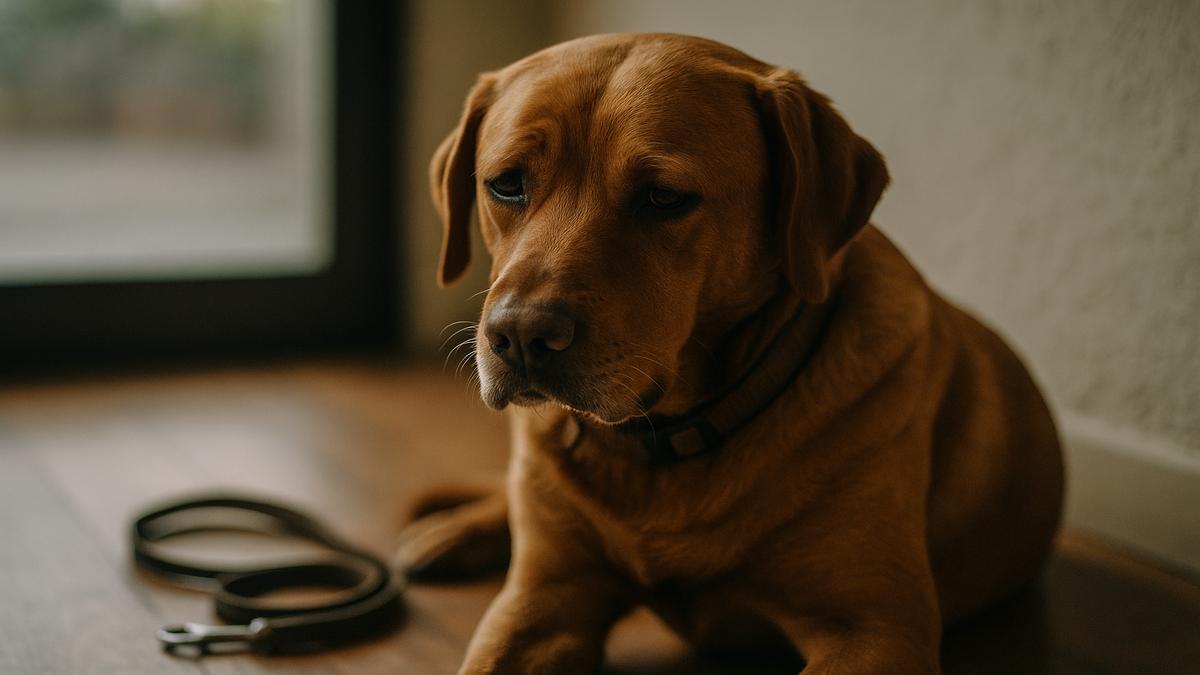
The first time Milo stopped at the end of the driveway, Jenna laughed. “Come on, bud,” she chirped, giving the leash a gentle tug. For seven years this golden retriever had practically dragged her down the sidewalk, tail helicopter-whirling, nose buried in every hedge. But this time he planted his paws and turned his head toward the front door, eyes soft, ears pinned back just slightly. The second time it happened, she tried coaxing with treats. The third time, she wondered what she’d done wrong. By the end of the week, Milo wasn’t just hesitating; he was quietly refusing. A dog who used to live for morning walks now stood trembling at the threshold, as if there was something out there that only he could see.
The Walk That Quietly Changed
If you’ve ever stood there, leash in hand, staring at a dog who suddenly wants nothing to do with walks, you know the sting of confusion that follows. You replay the last few outings in your head. Did a loud truck spook them? Did a dog bark at them from behind a fence? Did you scold them too sharply yesterday when they lunged at a squirrel?
Most people assume it’s fear or stubbornness. Some shrug it off as aging. “He’s just getting old,” they say, or “She’s being dramatic.” But for many dogs, especially after the age of seven, that sudden reluctance to go for a walk isn’t attitude. It’s a silent, physical symptom — one that more than 90% of owners miss at first because it doesn’t look like the pain we expect to see.
We think pain means limping, yelping, or refusing to put weight on a leg. But dogs are masters of quiet suffering. Their wild ancestors survived by hiding pain; showing vulnerability could mean becoming someone else’s dinner. That survival instinct is still very much alive in your couch-sleeping, toy-hoarding best friend.
So they keep walking, even when it hurts — right up until one day, they can’t bring themselves to step off the porch.
The Silent Symptom Hiding in Plain Sight
Imagine slipping on shoes that are half a size too small, then being told to jog the same route you’ve always run, day after day. Or picture a dull, grinding ache in your knees every time you go down the stairs. You’d still manage, especially at first. You’d probably brush it off, complain quietly, adjust your pace. But eventually, there would come a morning when you’d stare at those shoes and think, “Not today.”
For so many dogs, that “not today” moment around age seven is the first visible sign of something invisible: chronic pain. Often it’s early arthritis, spinal discomfort, joint degeneration, or even subtle injuries you never saw happen. The tricky part? You almost never see your dog “act injured” in the dramatic way you expect.
Instead, the body language is soft, almost forgettable:
- A slight pause at the door where they used to sprint.
- Needing more encouragement to start moving.
- Stopping on the driveway, as if considering their options.
- Walking slower on the way out and faster on the way home.
- Clean, tidy paws — because they’re no longer zooming through dirt and grass like they used to.
What looks like grumpiness, stubbornness, or “getting boring with age” is often a dog quietly negotiating with discomfort. The walk itself hasn’t changed. Their body has.
Age Seven: The Unseen Turning Point
Seven is not “old” for most dogs — at least, not in the way we think of old. They still chase balls, still greet you at the door with wiggling joy. But internally, the wear and tear of years of running, jumping off couches, skidding around corners, and leaping from car seats can start to add up.
In many dogs, especially medium and large breeds, age seven is when small joint changes finally cross an invisible threshold. Cartilage thins just enough. Muscles support the joints a little less. Those tiny bone spurs that have silently developed on knees, hips, or spine finally make their presence known. Not loudly. Just enough to turn a favorite pastime into something your dog suddenly wants to avoid.
The hard part? You don’t see those changes like you see gray fur on their muzzle. You see behavior. And behavior is easy to misinterpret.
What It Feels Like From Your Dog’s Point of View
Picture the world from the end of your dog’s nose on a cool evening. The air is full of scent stories: the rabbit that crossed the yard at dawn, your neighbor’s cooking drifting from an open window, the lingering perfume of another dog’s walk half an hour earlier. Your dog wants to go. The desire is still there, alive and burning behind their eyes.
But when they shift their weight to step off the porch, there’s a small stab of pain in a back leg, or a grinding feeling in a shoulder, or a sharp twinge across the lower spine. Maybe it’s not even sharp — maybe it’s a heavy, aching fatigue that makes every step feel like wading through mud.
So they hesitate. Their brain is pulled between two forces: instinct and discomfort. The leash tightens. You call their name again, a little more impatient this time. They lick their lips, blink, look away — subtle signs of stress that most of us never connect with physical pain.
For a moment, wanting to please you wins. They step forward, walk halfway down the block, then stop again. You tug. They plant their feet. You sigh, wondering why your once-happy walker has turned into a stubborn mule.
But stubbornness isn’t the right word. What you’re seeing is a negotiation — between a body that hurts and a heart that still wants to try.
The Small Clues You’ve Probably Overlooked
Once you know to look for it, the mosaic of tiny changes often starts to come into focus. Most people can think back over the previous months and suddenly realize: it wasn’t just the walks. The signs were there all along, whispering instead of shouting.
Maybe you’ve seen one or more of these shifts and brushed them off as “getting older” or “being lazy”:
- They no longer jump into the car without hesitation; they pause, then scramble or need a boost.
- Stairs are slower, especially on the way down.
- The zoomies that once tore through your living room now happen less often, if at all.
- They lie down more during play, or choose to chew a toy rather than chase it.
- When they get up from a nap, they stand still for a moment before moving, as if waiting for their joints to “wake up.”
- They’re more reluctant to be touched on certain areas — not snapping, just tensing or shifting away.
Individually, each of these things is easy to dismiss. Together, especially when combined with a new dislike for walks, they start to paint a much clearer picture: your dog may be trying, very politely, to tell you that something hurts.
The Difference Between “Doesn’t Want To” and “Can’t Comfortably”
It’s tempting to label a dog as stubborn or spoiled when they stop wanting to do the things we think should make them happy. But behavior is communication. And with dogs, especially aging ones, reluctance is often a body problem masquerading as a mind problem.
One helpful way to think about it is this: has something about their entire relationship with movement changed, or only specific situations?
Look at the patterns:
| What You Notice | More Likely Emotional | More Likely Physical |
|---|---|---|
| Refuses only certain routes or locations | Possible fear of specific place, noise, or event | Still possible, but check for patterns |
| Slower overall, on every walk and every surface | Less likely | Common sign of pain or fatigue |
| Still plays eagerly at home, but freezes at the door | Can be fear-triggered | Pain may be worse on specific surfaces/temperatures |
| Reluctant with stairs, jumping, or getting up | Uncommon | Strong indicator of joint or spine discomfort |
| Changes in gait, stiffness, or licking at joints | Rare | Classic signs of chronic pain |
Of course, life isn’t always either/or. A dog may develop pain and, after one or two bad experiences outside, also start to associate walks with discomfort or fear. But if your dog has crossed that invisible age-seven threshold and something about the way they move, climb, jump, or walk has shifted, you should treat it as a physical red flag until a vet proves otherwise.
The 90% Moment: When Owners Finally See It
There’s a moment that happens again and again in vet clinics. A dog who “just doesn’t like walks anymore” comes in for an exam. The vet gently bends a knee, rotates a hip, or presses along the spine. The dog flinches, tenses, or looks back in surprise. Sometimes they even let out a small cry.
The owner’s face changes. Shock. Guilt. Then relief, oddly enough — because there is an explanation, and that means there can also be a plan.
“I had no idea,” they say. “But now that you mention it, he does take longer to get up. And she has been licking that back leg more. And come to think of it, she hasn’t jumped on the bed in months.”
This is the silent symptom most of us miss: that first, subtle shift in willingness. Not the full-on limp. Not the obvious injury. Just the quiet “no, thank you” at the door.
Helping Your Dog Love Movement Again
If your dog has started to hate walks after seven, the most loving thing you can do is assume their body is talking to you. Don’t punish. Don’t drag. Don’t force them to “push through it.” Instead, get curious and gentle.
Here are some places to start:
- Schedule a thorough vet check. Ask specifically about joints, spine, and mobility. Mention every small change you’ve noticed — even if it seems trivial.
- Ask about pain relief options. There are medications, supplements, and therapies that can dramatically improve comfort when used under veterinary guidance.
- Re-evaluate the gear. Heavy collars, ill-fitting harnesses, or old, stiff leashes can add strain. A well-fitting harness that doesn’t pull on the neck can make a big difference.
- Adjust the walk itself. Shorter routes, softer surfaces (like grass instead of concrete), and slower paces can make walking feel possible again.
- Warm up, just like athletes do. A few minutes of gentle indoor movement before heading out can help loosen stiff joints.
Think of walks as a conversation now, not a chore. If your dog refuses, ask why with your eyes, not your frustration. Are they more willing at different times of day? Is cold weather worse than warm, or vice versa? Do they seem better on quiet side streets than busy, noisy roads? Every answer is a clue.
When It’s Not Pain (But Still Very Real)
While pain is an enormous, often-missed player in the “my dog suddenly hates walks” mystery, it’s not the only one. Around the same age, some dogs also start experiencing changes in hearing, vision, or cognitive function that can make the outside world feel less predictable and more overwhelming.
A dog whose eyesight is slightly dimmer may be startled more easily by shadows or fast-moving objects. A dog with fading hearing might not understand where a sudden noise came from. As their brain ages, some dogs become more anxious about leaving safe, familiar spaces. The street they’ve always walked suddenly feels too big, too loud, too much.
And again, the symptom can look exactly the same: a quiet refusal at the door.
This is why it’s so important not to jump to a single conclusion — or to no conclusion at all. Your job isn’t to instantly know what’s wrong. Your job is to listen when your dog begins to say, in the only way they can, that something about the world has changed for them.
Rewriting the Story of the Walk
After Milo’s third stubborn stand in the driveway, Jenna did what so many of us put off: she booked a vet appointment. X-rays showed early arthritis in his hips and a bit of spinal change. Nothing dramatic, nothing catastrophic. Just enough, the vet explained, to make long, concrete-heavy walks feel like work instead of joy.
They made a plan. A gentle anti-inflammatory, some joint supplements, a new harness that didn’t pull across his neck. Shorter walks on softer ground. More sniffing breaks, fewer brisk marches.
The first time they tried the new routine, Milo still paused at the door. Old habits of worry linger. But Jenna didn’t tug this time. She knelt next to him, scratched his chest, and waited. “We’ll go as far as you want,” she said quietly. “No pressure.”
He stepped forward, slowly. They took the side path through the park instead of pounding the sidewalk. They stopped so he could press his nose into the grass, tracing invisible stories with renewed interest. Halfway through, he looked up at her with that familiar spark — not the wild puppy zoomie spark, but something steadier. Something like: this feels okay.
The walk was shorter than their old ones, but it felt bigger somehow. Not in distance, but in understanding.
That is the silent shift on our side of the leash — the one that matters just as much as what’s happening in their joints. The moment we stop demanding the dog we used to have and start honoring the dog we have right now, in this body, at this age, with these needs.
Because your dog doesn’t hate walks. Not really. They hate walking that hurts. They hate stepping into a world that hasn’t adjusted to meet the body they’re living in now. When you change the walk — in length, in pace, in expectations, in tenderness — you often find that their dislike wasn’t of the world at all. It was of the ache they didn’t know how to tell you about.
So the next time your seven-plus-year-old dog stops at the threshold, pause with them. Look not for defiance, but for a message. Maybe it’s time for a vet visit. Maybe it’s time to trade distance for delight, speed for sniffing, routine for gentleness. The most important walk you’ll ever take together might not be the longest or the fastest. It might be the one where you finally listen.
FAQ
My dog is only seven. Isn’t that too young for arthritis or chronic pain?
Not at all. Many dogs show early signs of joint changes between ages five and eight, especially medium and large breeds or very active dogs. These changes may be mild but still uncomfortable enough to make walks less appealing.
How can I tell if it’s pain or just stubborn behavior?
Look at the bigger picture: changes in jumping, stairs, getting up, speed, or willingness to play can all point toward pain. If your dog shows several of these along with a new dislike of walks, a vet check is strongly recommended.
Could my dog just be scared of something outside?
Yes, fear can also cause walk refusal. Loud noises, bad experiences with other dogs, or environmental changes can all play a role. However, especially after age seven, it’s wise to rule out pain and medical causes before assuming it’s purely behavioral.
What should I ask my vet if my dog suddenly hates walks?
Tell your vet exactly what has changed and when. Ask about joint exams, pain assessment, and whether imaging (like X-rays) is needed. Also ask about safe pain relief, joint support supplements, and lifestyle adjustments for your dog’s age.
Can dogs regain their love for walks after starting treatment?
Many can. With proper pain management, adjusted exercise, and supportive gear, a lot of dogs show clear improvement in enthusiasm and comfort. The goal is not to force long walks again but to rediscover movement that feels good for them at this stage of life.

Hello, I’m Mathew, and I write articles about useful Home Tricks: simple solutions, saving time and useful for every day.