The first time I spent the night in a working bakery, I left with a paper bag tucked under my arm like a secret. Inside was a still-warm loaf, crackling softly as it cooled, the crust whispering and sighing in the chilly dawn air. The baker, a man with flour permanently etched into the lines of his hands, had watched me cradle that loaf like a newborn. “Don’t put it in plastic,” he called after me as I stepped into the street. “Or you’ll kill it by morning.”
I laughed then, thinking he was joking. How could a loaf of bread—this sturdy, ancient food—be that fragile? But the next morning, I woke to a disappointment that felt strangely personal. The loaf was there, but the magic was gone. The crust, once shatteringly crisp, had turned soft and rubbery. The inside had lost its tender spring, leaning instead toward dry and tired. It wasn’t moldy, it wasn’t rotten. It was worse: it was stale.
It took years, and more loaves than I’d like to admit, to understand what that baker meant. And it all comes down to one quiet mistake almost everyone makes with bread—the one that can transform your beautiful loaf into a sad, stiff echo of itself overnight.
The One Mistake: Suffocating Your Bread
The mistake is surprisingly simple: we smother bread in plastic or seal it up while it’s still warm, trapping its breath, its moisture, and its life inside. We treat it the way we treat leftovers—locked away, isolated from the air, as if oxygen is the enemy. But bread is not a casserole, and a fresh crust is not meant to live in a plastic prison.
Fresh bread is both sturdy and delicate. Inside, the crumb is a network of starches and proteins that are constantly changing from the moment the loaf leaves the oven. On the outside, the crust is a fragile shell, rigid from the rapid drying and caramelization that happened in the heat. When you slip that still-warm loaf into a plastic bag, the steam that should have gently escaped is forced to linger. It condenses, seeps into the crust, and begins undoing all the work the oven did.
By morning, the crust that sang under your fingers has turned flabby and damp, then oddly tough as it cools and sets. Worse, that trapped moisture doesn’t just make the crust unpleasant; it speeds up the quiet, invisible process that makes bread go stale. The tragedy is that most people blame the bread, not the bag.
What “Stale” Really Is (And Why It’s Not Just Dryness)
There’s a quiet, scientific drama unfolding inside every loaf of bread long after it comes out of the oven. We tend to think stale means “dry,” as if the bread simply lost a battle with the air and all its moisture evaporated overnight. But the truth is stranger, and almost more poetic: bread goes stale even if you lock it away where it can’t dry out at all.
Inside that crumb, the starches that once swelled with water in the oven begin to reorganize themselves as the bread cools. This is called retrogradation, a word that sounds like something a planet does, but it’s really just the starch chains slowly straightening and lining back up. As they realign, they squeeze out water molecules that were once nestled inside them. The result? The texture shifts from tender and elastic to firm and crumbly.
This process happens fastest at cool room temperatures—precisely the kind of environment where you might lovingly tuck your bread in for the night. Put a loaf in the refrigerator, and you’re speeding up retrogradation dramatically. Seal it warm in plastic, and you’re adding extra moisture and condensation to the mix, softening the crust and driving the internal changes harder.
So no, “stale” doesn’t simply mean “dry.” A stale loaf may still technically contain most of the water it had when it left the oven. The water has just moved, returning the starch structure to a more rigid, crystalline form. It’s less a loss of water and more a rearrangement of it. That’s why bread can taste dry even though it isn’t truly dehydrated.
Why That Plastic Bag Is the Silent Villain
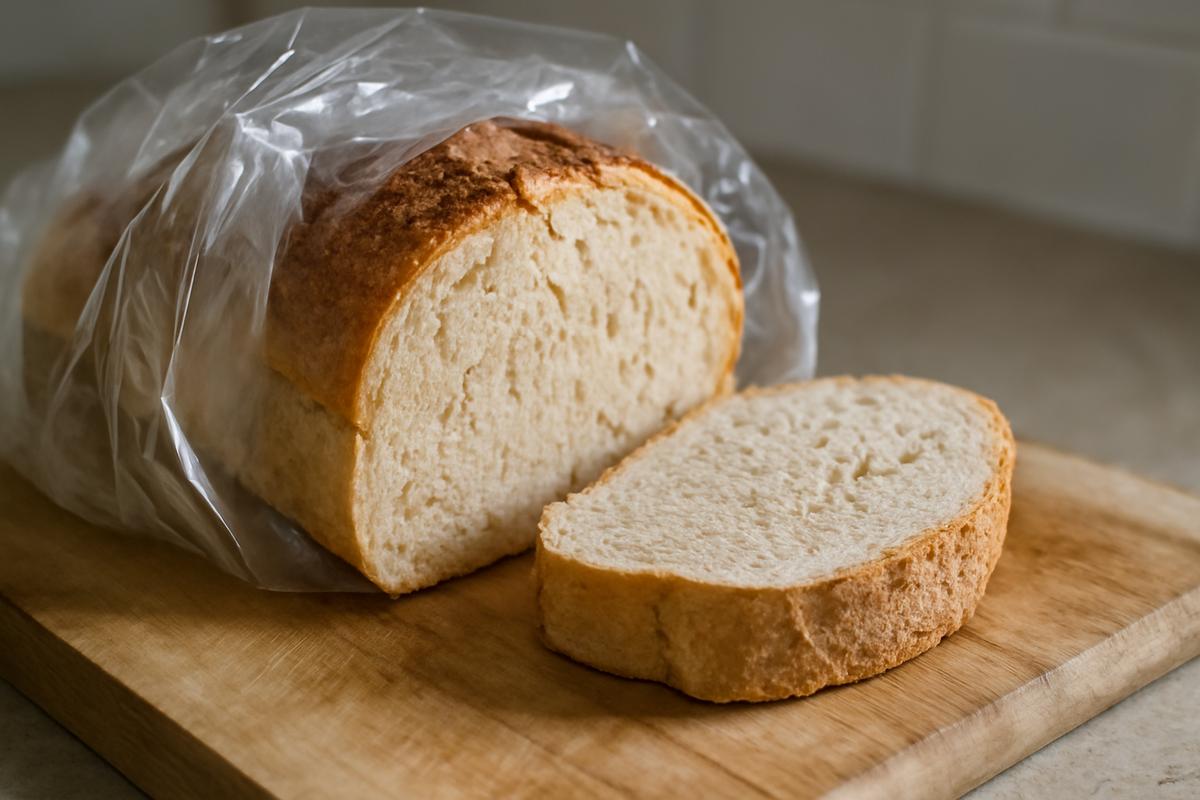
Picture a loaf of bread sitting on the counter, completely unwrapped. Over time, yes, it will dry out. Air will gradually pull moisture from the crumb, and the crust will become rock hard. That can take a couple of days, sometimes more, depending on the bread. But now imagine that same loaf, still radiating a little warmth, wrapped snugly in a plastic bag moments after you get home from the bakery.
Within minutes, condensation starts to form inside the bag. Tiny droplets bead on the inner surface, then roll down and soak the crust. The crisp outer shell, which was designed by heat and steam to be dry and structured, begins to absorb this moisture. You can’t see the starch chains inside shifting and reorganizing, but they are, more quickly and more aggressively than if you had let the loaf breathe. By the time you wake up the next morning, the bread isn’t simply “less fresh.” It has dramatically changed form.
And yet plastic is tempting. It’s what the supermarket uses for sliced sandwich loaves, so it looks like the sensible choice. But those soft, supermarket breads are a different species entirely. They’re often formulated with oils, sugars, conditioners, and preservatives that delay staling and keep the crumb pillowy. Their crusts, if you can call them that, were never meant to shatter. When we take the habits built around factory-soft bread and apply them to a naturally baked loaf with crackling crust and a lively crumb, we’re accidentally sabotaging it.
The irony is sharp: in our effort to keep bread “fresh,” we often push it to feel stale faster.
How to Store Bread So It Still Feels Alive Next Day
Once you see plastic as the quiet villain, the next question becomes obvious: what does bread actually want? If a loaf could talk, what would it ask us to do after we walk it home in its crinkly paper bag?
Let It Cool and Breathe
First, give the loaf time. If it’s still even slightly warm, leave it out, unwrapped or loosely covered with a clean towel. Let the last of the internal steam escape. Those final wisps of heat are a continuation of the baking process, and if you trap them, you’re interrupting the loaf mid-sentence.
Use Paper, Not Plastic (At Room Temperature)
For short-term storage—say, overnight or for one or two days—paper is your friend. A simple paper bag (or the one from the bakery) is often enough. If the air in your home is very dry, you can put the loaf in a paper bag and then tuck that into a bread box or a loosely closed cabinet. This lets the bread breathe while slowing down the harshest effects of air exposure.
The crust will gradually soften a bit over time, yes, but not in the damp, rubbery way plastic induces. The crumb will hold onto its character longer, and you’ll avoid the sweaty, sad texture that makes a good loaf feel like it slept in the wrong clothes.
Only Slice What You Need
Another quiet trick: don’t slice the entire loaf at once. Every cut exposes more surface area to the air, and that speeds up moisture movement and staling. Instead, slice only what you need, keeping the rest of the loaf intact. If you’ve already cut into it, store it cut side down on a board or plate so that the exposed crumb isn’t directly facing the open air.
Freeze, Don’t Refrigerate
The refrigerator is where bread goes to age before its time. Cold temperatures dramatically accelerate starch retrogradation, making bread go stale faster even though it may feel “moist” from condensation. If you know you won’t finish a loaf within a couple of days, your best ally is the freezer, not the fridge.
Slice the portion you plan to freeze. Wrap it in paper first, then slip it into a plastic bag or sealed container just for the freezer. When you’re ready to eat, you can toast straight from frozen or let the slices thaw at room temperature, then reheat briefly to revive their texture.
The Magic of Reheating: Bringing Bread Back from the Brink
Here’s a slightly miraculous detail about bread: staling, at least for a while, is partially reversible. That rearranged starch structure, the one that pushed out water and turned your loaf firm and dull? Heat can coax it back, softening and loosening the chains again. It won’t make a week-old loaf indistinguishable from a just-baked one, but it can get surprisingly close.
If your bread is only a day or two old and feeling a bit tired, try this: preheat your oven to around 160–180°C (320–350°F). Lightly spritz the crust with a bit of water or run your hands under the tap and gently pat the outside. Then place the loaf directly on the oven rack for 5–10 minutes. When it emerges, the crust will have regained its crispness, and the interior will feel more tender and lively again. Eat it soon after; the revived magic doesn’t last long.
For sliced bread, a toaster works the same sort of spell. What you’re doing, on a microscopic level, is gently nudging those starches out of their rigid state and redistributing some of the moisture. This doesn’t undo all the passage of time, but it’s enough to remind you that even slightly stale bread has one more story to tell before it becomes breadcrumbs or croutons.
A Quick Look at What Really Happens to Bread
To see how all of this ties together, it helps to lay out the basics in a simple comparison. Think about what happens to a loaf in different storage situations:
| Storage Method | What Happens to Crust | What Happens to Crumb | Best Use |
|---|---|---|---|
| Warm bread sealed in plastic | Turns soft, damp, then tough | Stales faster due to trapped moisture and rapid retrogradation | Almost none; use for toast, croutons next day |
| Room temp in paper bag | Stays reasonably crisp, slowly softens | Stales slowly; good texture for 1–2 days | Everyday eating, short-term storage |
| Loose, cut-side-down on board | Crust remains crisp but may become quite hard | Exposed area dries faster, but loaf keeps flavor | Crust lovers, quick daily use |
| Refrigerator in plastic or paper | Often rubbery or leathery | Stales fastest; feels oddly dry yet moist | Not recommended, except for very moist loaves prone to mold |
| Freezer, wrapped well | Holds up if reheated or toasted | Texture preserved; revive with heat | Long-term storage, sliced breads, batch baking |
Living With Bread Instead of Fighting It
Once you understand that bread is a living, shifting object rather than a static product, your habits start to change in small but telling ways. You stop buying more than you can reasonably eat in a day or two unless you’re willing to freeze. You look for paper bags instead of plastic sleeves. You slice from the end instead of from the middle, preserving the loaf’s structure a little longer.
You may even start to enjoy its aging. Day-one bread, with its explosive crust and steamy crumb, is perfect for tearing, dipping in olive oil, smearing with butter that melts on contact. Day-two bread, a little more settled, makes better toast or open-faced sandwiches. Day-three bread turns into croutons, panzanella, strata, or golden-edged slices soaked in egg for French toast. Beyond that, it becomes breadcrumbs, ready to coat or thicken or sprinkle.
Seen this way, bread isn’t either fresh or stale, alive or dead. It’s moving through stages, each with its own best use. The real loss happens only when we push it prematurely into that overnight limbo where it’s neither crisp nor soft, neither springy nor firm. And the one mistake that sends it there—sealing a warm loaf into plastic, suffocating it with our good intentions—is so easy to avoid once you’ve watched it happen a few times.
I still think about that baker, watching me cradle the loaf that night. At the time, his warning sounded almost superstitious. Now I hear it as an invitation to pay attention. Bread asks us to meet it where it is, to accept that it will change and that our job is to guide those changes instead of fighting them. Give it air. Give it time. Give it a chance to breathe before you try to keep it.
The next time you bring home a beautiful loaf, try this: leave it in its paper bag, or bare on the counter, until it’s fully cool. Resist the urge to “protect” it in plastic overnight. Slice just what you need. Listen to the crackle as your knife breaks the crust. Feel the spring of the crumb under your fingers. Then, in the quiet of the morning after, when you bite into a slice that still feels alive, you’ll understand how such a small choice can change everything.
Frequently Asked Questions
Why does my bread go stale so fast, even in a sealed bag?
Because staling isn’t just about bread drying out. Inside the loaf, starch molecules are constantly reorganizing, pushing water out and making the crumb firm and dull. A sealed plastic bag traps moisture, softens the crust, and can actually speed up this internal change, especially if the bread goes in while still warm.
Is it ever okay to use plastic for storing bread?
Yes, but with care. For very soft sandwich loaves, plastic helps keep the crumb moist and tender. For crusty, artisan-style breads, plastic is best avoided at room temperature. If you do use it, make sure the bread is completely cool first, and consider using it only for freezing, with paper as the first layer against the crust.
Should I keep bread in the refrigerator to make it last longer?
Generally no. The fridge slows mold growth but speeds up staling by accelerating starch retrogradation. Bread kept in the refrigerator often feels dry and stale faster, even if it hasn’t lost much moisture. For longer storage, freeze instead.
How long can I keep bread at room temperature?
Most crusty loaves are at their best within 1–2 days at room temperature when stored in paper or in a bread box. Softer loaves can last 3–4 days. After that, flavor and texture decline. At any point past day two, think about toasting, reheating, or turning the bread into something new like croutons or breadcrumbs.
What’s the best way to freeze and thaw bread?
Slice the bread first, wrap it in paper to protect the crust, then put it into a plastic bag or airtight container. Freeze promptly. To use, toast slices straight from frozen or let them thaw at room temperature, then warm briefly in the oven or toaster to revive the texture. This preserves much more of the original quality than refrigerating.

Hello, I’m Mathew, and I write articles about useful Home Tricks: simple solutions, saving time and useful for every day.