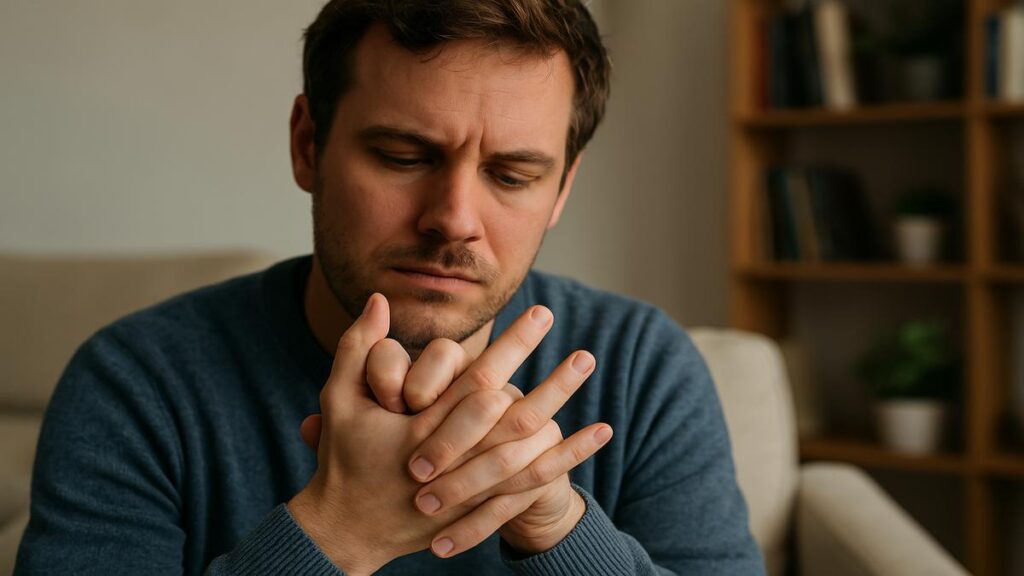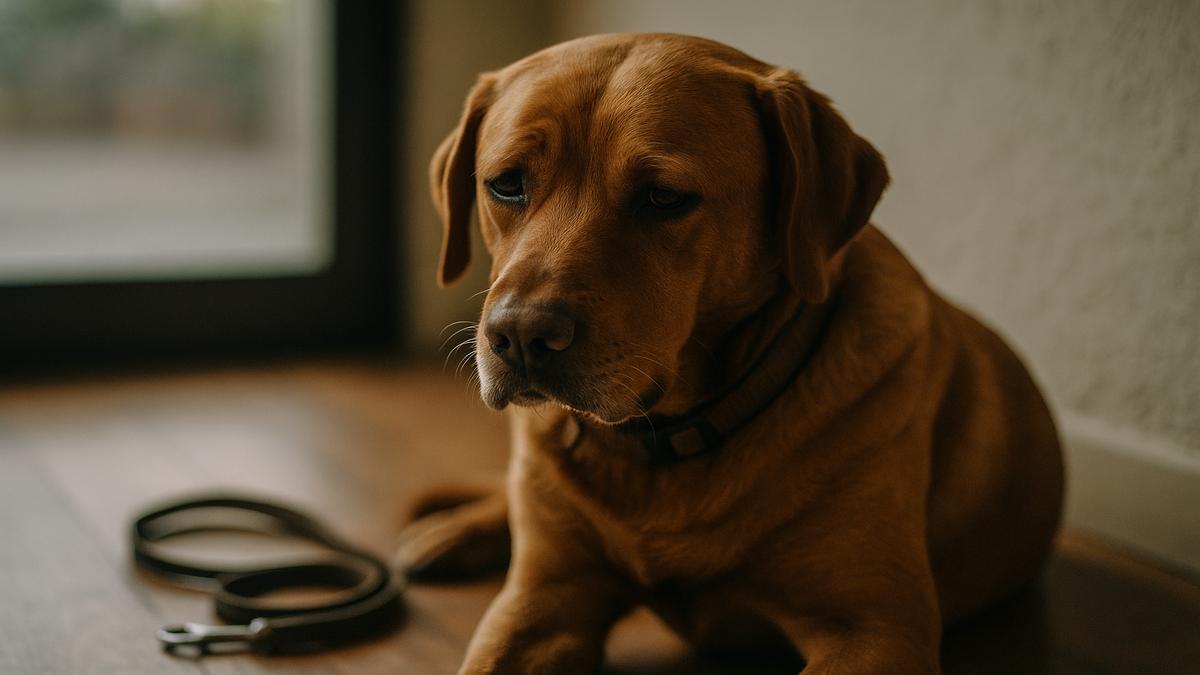
The leash is already in your hand when you notice it—that tiny hesitation where there used to be a joyful explosion. Your dog watches you from across the room, eyes soft but unsure. The tail that used to thump wildly against furniture barely sways. You jingle the leash like always. Once, that sound was a starter pistol; now, it’s a question. “Hey, buddy,” you say lightly, forcing cheer into your voice. “Want to go for a walk?”
He blinks. Licks his lips. Maybe he stands up, but slowly, like an old man getting out of a chair. At the front door he pauses, glancing back over his shoulder as though asking for reassurance you don’t yet realize he needs. And that’s the moment—the silent symptom—that 90% of owners miss. It doesn’t look like drama. It looks like a mood. A phase. A quirk. But for many dogs over seven, the sudden shift from “Let’s go!” to “Do we have to?” is not attitude.
It’s pain.
The Walk That Quietly Changes
Picture your usual route: the worn curve of sidewalk where your dog always stops to sniff the same mailbox, the one yard where the wind always seems to carry the scent of something fascinating, the patch of shade where you often pause on hot days. You know the rhythm of this route like a favorite song—at least, you used to. Lately, the beat is off.
Your dog starts lagging behind halfway down the block. You shorten the walk, telling yourself it’s just the heat, or maybe he’s “being lazy today.” He used to pull you toward the park; now he walks next to you or trails behind. The stairs at the corner? He takes them more carefully now, one slow step at a time. Sometimes he stops completely, as if he’s reconsidering this whole walking idea.
You check his paws. No cuts. His nose? Still cold and damp. He eats, drinks, naps. Nobody’s limping dramatically. No yelps. No obvious injury. So you shrug, clip the leash back onto the hook when you get home, and figure you’ll try again tomorrow, maybe earlier, maybe later, maybe when the weather’s better.
Tomorrow arrives. He hesitates again.
The Silent Symptom 90% of Owners Miss
Most people expect pain to look loud: limping, crying, refusing to stand, or whining all night. Sometimes it does. But far more often, especially in older dogs, pain is a whisper. A small behavioral shift. A change so subtle it hides inside normal life.
For many dogs over seven, the first real sign of pain isn’t a limp. It’s this: they stop loving walks.
They don’t always refuse outright. They might still go—but with reluctance. Or they’ll start strong and fade halfway. They may seem distracted, stubborn, or oddly anxious. Owners often label this as “slowing down,” “getting old,” or “being weird about walks lately.” But what’s really happening is that your dog’s brain has quietly started building an association between “leash,” “front steps,” “sidewalk,” and one private reality:
That hurts now.
Dogs are deeply wired to mask vulnerability. In the wild, broadcasting pain is dangerous. So they get good at disguising it—in posture, in gait, in expression. What they can’t quite hide is their behavior around what consistently triggers the pain. For many seniors, that’s movement. Especially the kind of movement we call “going for a walk”: repetitive, sustained, often on hard surfaces, with stairs, curbs, and turns that test joints and spine.
How Pain Quietly Rewrites Your Dog’s Favorite Ritual
Imagine waking up with sore knees every day. Not excruciating. Just…stiff. Tight. You stand, and there’s a pinch in your lower back, a scrape of discomfort in your hip. You’d still go about your day, but suddenly the idea of a brisk, mile-long walk on concrete? Not as inviting as it used to be.
Your dog can’t say, “My hips kill me after the second block.” So instead, he slows. He balks at the door. He drags his paws a little. His tail carriage lowers, especially on the second half of the walk. Maybe he plants his feet at the driveway and looks at you as if to say, “Can’t we just stay here?”
We misread this all the time: as stubbornness, as fear of something outside, as “he’s just being difficult.” But for many dogs over seven, this new dislike of walks is an early warning siren for:
- Arthritis (degenerative joint disease)
- Hip or elbow dysplasia that’s finally catching up
- Spinal issues like spondylosis or intervertebral disc disease
- Soft tissue pain from old injuries you forgot about but their body did not
- Neurologic changes that make coordination harder, so walks feel unsafe
It’s not that they no longer enjoy being outside with you. It’s that the price of that joy has gone up, and they’re quietly trying to tell you the math no longer works.
The Tiny Clues Hiding in Your Daily Routine
Once you know how pain disguises itself, you start seeing it everywhere. The signs are rarely dramatic. They’re small, everyday edits your dog makes to survive the day a bit more comfortably.
Here are patterns many owners notice only in hindsight—after a vet finally diagnoses arthritis or chronic pain:
| Subtle Change | What You See | What It May Mean |
|---|---|---|
| Walk reluctance | Hesitation at leash, stopping early, slower pace | Movement causes joint or spinal pain |
| Stair “carefulness” | Taking stairs one at a time, avoiding them when possible | Hips, knees, or back hurt under load |
| Jumping less | No longer jumps into car, on bed/sofa, or onto favorite chair | Pain during takeoff/landing or fear of slipping |
| Personality “softening” | Quieter, clingier, less playful, or more irritable | Chronic discomfort draining their emotional bandwidth |
| Grooming changes | Licking joints, chewing feet, avoiding certain brushes | Local pain or tingling, compensatory strain |
Walks are where these changes show up the clearest because walks ask the most of your dog’s body in a focused burst of time. When they start opting out of the very thing they once lived for, that’s your cue to lean in and pay attention.
The Age Seven Shift: What’s Really Going On Inside
Age seven isn’t a magical switch, but it is a common tipping point. Many medium and large dogs are entering their senior years by then; smaller dogs follow a little later, but their joints still carry the weight of every chase, jump, and wild zoomie they’ve ever done.
Inside their body, cartilage has been slowly wearing down. Micro-tears in ligaments, once shrugged off, have left microscopic scars. Inflammatory processes simmer quietly in the background. Nerves become more sensitive, muscles compensate for weaker joints, and the smooth glide of motion becomes a little more gravelly.
At six, that might have felt like, “I’m a bit stiff when I wake up, but I warm up quickly.”
By seven or eight, it can turn into, “I’m stiff when I wake up, and the more I move, the more everything protests.” That’s when the walks begin to change.
Because this decline is gradual, we normalize it. We tell ourselves, “He’s just older now,” as though aging and pain always have to travel together. They don’t. Aging is inevitable. Suffering isn’t.
Listening With Your Eyes, Not Just Your Heart
So what do you do when you realize the dog who once dragged you toward the horizon is now staring at the door like it’s a test?
You start observing like a detective instead of assuming like a narrator.
- Watch their body language before, during, and after the walk. Do they brighten when you pick up the leash, or flatten a little? Do they pant more, lag, or look over their shoulder often? Are they slower at the start, or only on the way home?
- Pay attention to transitions. Getting up from lying down, climbing into the car, hopping off the couch—are these slower, stiffer, or more deliberate than a year ago?
- Note surfaces and conditions. Hard concrete, slippery tiles, steep inclines, hot or cold pavements all amplify pain. Does your dog struggle more on certain routes or weather days?
- Feel for physical clues. After a walk, gently run your hands along their spine, hips, knees, and shoulders. Do they flinch, stiffen, or lick your hand away in certain spots?
These observations matter, because when you walk into your vet’s office and say, “He doesn’t like walks anymore,” that alone is a story fragment. When you can say, “He hesitates at the door, walks fine for the first five minutes, then slows, lags behind, and seems stiff getting up later,” you’ve turned that fragment into a map.
Bringing the Vet Into the Conversation
If your dog is seven or older and their walking behavior has changed, treat it as a medical question first, not a training or “attitude” problem.
Tell your vet:
- When the change started (roughly)
- What exactly has changed (pace, distance, enthusiasm, posture)
- What surfaces and situations are hardest for your dog
- Any previous injuries, even if they seemed minor
Your vet can check for range of motion, joint thickening, muscle loss, spinal sensitivity, neurologic changes, and more. They may recommend X-rays, pain relief trials, joint support supplements, weight management, or physiotherapy. Often, a short course of anti-inflammatory medication is used as a “diagnostic test”: if your dog suddenly moves like their younger self, you’ve got your answer.
This doesn’t mean their walking days are over. It means they need your help to keep them going in a way that feels good to their body now, not the body they had three years ago.
Redesigning Walks for an Aging Body (and Still a Young Heart)
Once you understand that the new walk reluctance is probably pain talking, everything about your routine can shift from frustration to compassion. This is where your role changes—from exercise buddy to thoughtful guide.
Make Comfort the New Goal
Instead of aiming for distance, speed, or step counts, build walks around how your dog feels, moment to moment.
- Shorter, sweeter walks. Several brief strolls can be kinder than one long trek. Let your dog decide when enough is enough.
- Soft surfaces over hard pavement. Grass, dirt paths, and forest trails cushion aging joints. Trade sidewalks for parks or quiet, soft-footed routes when you can.
- Wider, slower turns. Tight circles can pinch sore joints. Give them room to pivot and time to adjust.
- Warm up and cool down. Start with a few minutes of slow, easy walking before expecting normal pace. Finish the same way.
For some dogs, simple changes like using a well-fitted harness instead of a collar, adding non-slip booties for traction, or choosing level routes instead of steep hills can turn a dreaded outing back into a manageable one.
Let Their Nose Do the Heavy Lifting
Here’s a secret: your dog doesn’t rate the walk by miles; they rate it by smells. For an aging body, the most satisfying part of the walk—the mental workout of sniffing—is still entirely available, even when joints complain.
- Allow more sniffing breaks. Stand still. Let them read the news in every blade of grass.
- Try “sniffari” walks: slow, meandering routes where the only goal is exploration, not distance.
- On days where walking seems hard, create sniffing games at home—scatter food in the yard, hide treats in boxes, or lay simple scent trails across the house.
These are not consolation prizes. To your dog, they’re deeply satisfying. And because they tax the brain more than the joints, they offer enrichment without the physical toll.
When “No More Walks” Is Actually a Loving Answer
There’s a quiet, tender truth tucked inside all of this: at some point in your dog’s life, walks will change for good. For some seniors, even the most carefully adjusted strolls still ask too much of a failing body. The kindest choice may be to walk less, or not at all.
This can be heartbreaking. Walks are where so many of your memories live: the first awkward puppy outing, the late-night loops under streetlamps, the muddy adventures that left paw prints all over your car and your life. Letting go of that ritual feels like losing a part of your relationship.
But here’s the thing: the walk was never the point.
The point was always the togetherness. The shared rhythm of your footfalls and their paws, the mutual checking-in through glances and leash tension, the way the world seemed bigger and kinder with a dog trotting by your side.
You can still have that, even if your dog’s world shrinks to the backyard, the porch, or just the sunny spot by the window. You can sit in the grass together while the breeze ruffles their fur. You can turn the living room into a gentle playground of puzzle toys, massages, and conversation. You can love them fiercely at the pace their body now allows.
For a dog over seven who suddenly “hates” walks, the real question isn’t, “How do I make him like walks again?” It’s, “What is his body trying to tell me—and how can I honor that?”
When you answer that question with curiosity instead of frustration, compassion instead of denial, you become the person your aging dog needs most: not the one who drags them down the same old route out of habit, but the one who is willing to rewrite the routine in the language of comfort, safety, and quiet joy.
And one day, when you pick up the leash and your old friend lifts his head, you’ll no longer be asking, “Why doesn’t he want to walk like he used to?” You’ll be asking, “What would feel good for you today?”
That’s how you listen to the silent symptom most people miss.
FAQs
Why did my dog suddenly stop wanting to go for walks?
For dogs over seven, a sudden reluctance to walk is often linked to pain—usually from arthritis, joint disease, or spinal discomfort. Because dogs instinctively hide weakness, they rarely cry or limp dramatically at first. Instead, they quietly change their behavior: hesitating at the door, slowing down, or cutting walks short.
How do I know if it’s pain and not just stubbornness or mood?
Look for patterns beyond the walk itself. Is your dog slower getting up, hesitant on stairs, reluctant to jump into the car, or less playful? Does their pace drop midway through the walk? Do they seem stiff afterward? These clues together point much more to physical discomfort than to a behavioral issue.
Should I force my older dog to walk to “keep him active”?
No. Gentle movement is healthy, but forcing a painful dog to walk can worsen joint damage and build a negative association with going outside. Instead, shorten and soften walks, choose comfortable surfaces, and let your dog set the pace. Always talk to your vet about a safe activity level.
Can medication really make a difference for an older dog who hates walks?
Yes. Many owners are stunned to see their dog moving, playing, and even trotting happily again after starting appropriate pain relief or anti-inflammatory medication. A vet-guided pain management plan—often combined with joint supplements, weight control, and physiotherapy—can restore a lot of lost joy.
Is it okay if my senior dog barely walks anymore?
It can be, as long as their physical and emotional needs are met in other ways. Short potty strolls, sniffing games in the yard, gentle indoor play, massage, and quiet companionship can replace long walks. What matters most is not the number of steps, but the comfort, connection, and enrichment your dog experiences each day.

Hello, I’m Mathew, and I write articles about useful Home Tricks: simple solutions, saving time and useful for every day.