The first time I heard the rumor, I was standing in a dim kitchen that smelled faintly of lemon cleaner and old onions. The tiles under my feet—a once‑white checkerboard—were the color of weak coffee and regret. A cleaning professional, sleeves rolled, hands cracked from years of bleach and scrubbing, leaned her mop against the wall and said in that casual, world‑weary way: “You know, if people would just put a teaspoon of cheap dish soap in their mop bucket, half these floors would look brand‑new.” She said it like it was the most obvious thing in the world, like gravity or taxes or the way grout inevitably darkens where the sunlight never reaches.
The Day I Questioned My Floors
It took me a while to believe her. For years, my tile floors had their own quiet narrative: a trail of scuff marks leading from the front door to the fridge, ghostly rings where plant pots once stood, a map of tiny nicks and scratches at the kitchen threshold. They weren’t exactly dirty—just tired. No amount of mopping seemed to matter. I’d watch dirty water swirl down the drain and still see that dull, chalky haze staring back at me when the floor dried.
You probably know that haze. It’s the stubborn film that makes your tiles look like they’ve lived through a dust storm. You mop. It dries. You squint and tell yourself, “It must be the light.” But it isn’t the light. It’s residue—layer upon layer of leftover cleaner, minerals from hard water, microscopic bits of oil and soap from shoes and daily life—thin enough to be invisible up close, obvious enough to make your entire floor look perpetually secondhand.
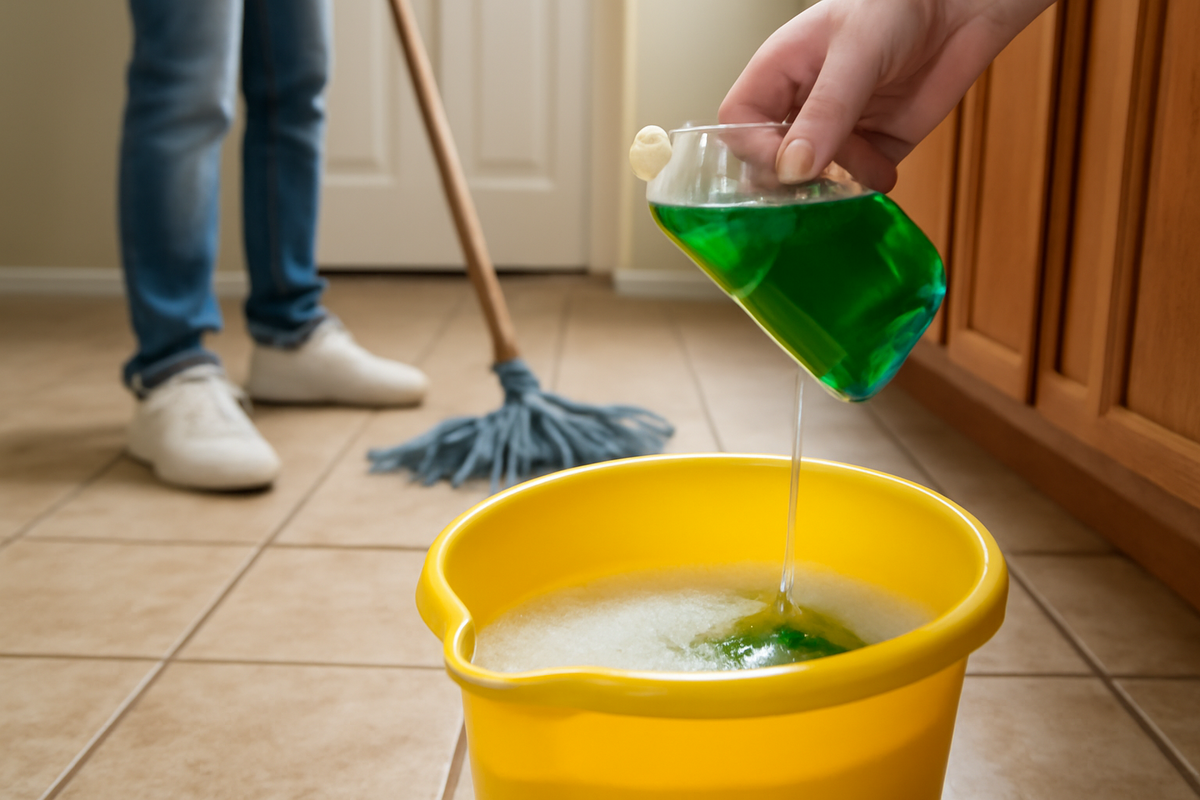
So, one afternoon, more out of curiosity than hope, I filled a bucket with warm water. No fancy floor cleaner, no pine-scented promises. Just water—and then, feeling strangely like I was breaking a rule, I added a single teaspoon of the cheapest blue dish soap I had under the sink. Not the plant-based, artisanal, responsibly harvested ocean-scented kind. The budget bottle. The one that doesn’t promise the moon, only clean plates.
The water went cloudy as the soap slipped in, cutting an iridescent swirl across the surface. It smelled faintly of kitchens and clean spoons, not floors. I dipped the mop, wrung it out, and dragged it across the tiles. The sound was different—smoother, quieter, as if the mop had been waiting for this exact combination all along.
The Quiet Science of a Teaspoon
There’s something oddly poetic about the idea that the solution to your tired floors might be measured in a teaspoon. Not a splash, not a glug, not a wild guess. A teaspoon. It’s the same measure you’d use for vanilla in a cake or sugar in your coffee—small, deliberate, almost ceremonial.
Behind this tiny measure, though, is a quiet bit of science. Dish soap is built for one purpose above all: to break down grease. It’s a surfactant, a kind of microscopic diplomat that convinces water and oil—two natural enemies—to work together. It lets water lift oily grime, food residue, skin oils, and everything sticky and clingy that ends up on your floors, then float them away.
Regular floor cleaners, especially when used too generously, can be oddly self‑defeating. They often contain waxes, shine agents, or heavy fragrances that cling to the tile. Used week after week, especially without a rinse, they start to build a film. Dish soap, in tiny doses, does the opposite: it helps strip those films away.
Here’s what that humble teaspoon in your mop water is actually doing:
- Breaking old residue: It loosens the foggy buildup left behind by stronger, stickier cleaners.
- Lifting oils and footprints: It targets the invisible stuff—skin oil, cooking grease, the faint film your socks and shoes leave behind.
- Releasing trapped dirt in grout: Grout is porous and clings to grime; dish soap helps water seep in and coax some of that out.
- Reducing streaks: Because there’s so little soap, there’s less for the floor to hold onto when the water dries.
But the magic is in the restraint. A teaspoon is just enough to help the water work smarter, not enough to leave its own stubborn memory behind.
The First Pass Across Old Tile
The real turning point wasn’t theory. It was that first slow walk across the kitchen, mop in hand. The tiles felt almost… squeaky. Not in a rubber‑on‑glass way, but in that faint, clean drag that tells you something is different underfoot. I worked in sections, dipping, wringing, passing the mop in laid‑back arcs across the once‑white squares.
The dirty water that collected in the bucket had a different look too—cloudier, murkier, with a slight rainbow sheen floating on top where the soap had trapped oils. The smell in the room shifted, away from “cleaning product” and closer to “freshly washed dishes.” It didn’t scream cleanliness. It whispered it.
The real test came after everything dried. For years, I’d grown used to a faint patchiness: duller near the stove, slightly grayer along the hallway, almost—but never quite—bright by the back door. This time, when the last dampness disappeared, the floor looked oddly even, like the tiles had agreed to remember their original color all at once.
Edges glowed a little more near the baseboards. Grout lines, though still the same deep tone, no longer looked smudged so much as simply shaded. The light from the window didn’t break into streaks when it hit the surface; it just slid, clear and simple, across the tile. There was no miracle transformation, no movie‑style gasp in the mirror, but there was something subtler: the quiet confusion you feel when your brain says, “Wait, this looks… new.”
Later, I watched a professional cleaner move through a rental property with the same trick. The entryway was laid with terracotta‑look tiles that had seen years of renters and rainy shoes. “Watch this,” she said, tipping in that now‑familiar teaspoon of dish soap. By the time she finished the living room, the floor looked less like a tired rental and more like a carefully chosen design feature.
The Teaspoon Trick in Everyday Life
Cleaners will tell you they don’t have time for gimmicks. Their loyalties lie with what works, not with whatever’s printed boldly on a label. Many of them keep that dish soap trick quietly in their mental toolkit—especially for older tiles that have seen too many layers of over‑eager cleaning product.
They’ll often use it:
- When floors look perpetually “cloudy” or dull, even after mopping
- After switching away from waxy or high‑fragrance cleaners
- In houses where cooking oil and steam drift from kitchen to hallway
- On rental or inherited floors that have lived whole histories before you arrived
What they do not do is glug soap in with abandon. Too much of a good thing, here, truly is too much. That teaspoon is a boundary line, a guardrail against the temptation we all have to think, “If some is good, more must be better.” With dish soap on floors, more is simply more streaking, more rinsing, more frustration. The teaspoon insists on moderation.
How to Try It Without Regret
If you find yourself eyeing your own old tile, wondering whether this might be the day you try the rumor, you can follow a simple, gentle routine. It doesn’t require special tools or heroic effort—just a bit of care and a willingness to move a little slower than usual.
| Step | What to Do | Why It Helps |
|---|---|---|
| 1. Sweep or vacuum | Remove loose grit, dust, and crumbs thoroughly. | Prevents scratching and mud‑like smearing when you mop. |
| 2. Fill bucket with warm water | Use enough to comfortably cover your mop head. | Warm water helps loosen oils and grime more easily. |
| 3. Add dish soap | Measure about 1 teaspoon of cheap, basic dish soap. | Gives you cleaning power without heavy residue. |
| 4. Mop in sections | Wring mop well; work in small areas, rinsing often. | Keeps dirty water from simply redistributing grime. |
| 5. Optional rinse | For sensitive floors, go over once with clean water only. | Removes any remaining soap, minimizing streaks. |
| 6. Let dry fully | Avoid walking on the floor until completely dry. | Prevents new footprints and lets you see the real finish. |
A few gentle cautions matter here. If your tiles are natural stone—like marble, limestone, or travertine—skip the dish soap altogether and stick with products made for stone; those surfaces can be more delicate and sensitive to certain cleaners. If your floor has a special finish, a glossy seal or coating applied professionally, test a small, hidden corner first to be sure the soap doesn’t dull it.
But for most ceramic and porcelain tiles, for the textured squares in hallways and the practical rectangles in kitchens, that teaspoon in the bucket is less a risk and more a reverse time machine, rolling back a few years of buildup in a single slow afternoon.
Why “Cheap” Dish Soap, Specifically?
There’s a whisper of class commentary in that word “cheap,” but in this case it’s pleasantly literal. When cleaners say “a teaspoon of cheap dish soap,” they’re usually pointing to something very specific: the straightforward, no‑frills formulas that don’t try to do everything at once.
High‑end dish soaps often come loaded with extra moisturizers, conditioners, fragrances, dyes, and mysterious “shine” additives. Those might be kind to your hands or nice for your plates, but on your tile floors they can behave like the very residue you’re trying to escape. The bargain bottle, on the other hand, tends to be simpler: strong at cutting grease, weak at leaving anything behind.
The cheap stuff:
- Rinses off more easily
- Usually has fewer conditioners that cling to surfaces
- Is designed with performance, not perfume, at the forefront
When the goal is to make tile look newly installed, what you really want is absence—no film, no perfumed layer, no faint rubbery shine. Just clean surface, catching the light honestly.
When a Floor Starts to Remember Its Youth
There is a particular beauty in old things that are allowed to be old without being neglected. Think of a well‑used wooden table: the scratches remain, but someone has wiped and oiled it into a soft glow. Tile floors are the less glamorous siblings in that family. They don’t have the romantic patina of antique wood, but they, too, carry the story of every day you’ve crossed them.
When cleaners say a floor can look “newly installed,” what they really mean, most of the time, is that it can look freshly honored again. The grout will still show its years in tiny ways. The corners may hold a chip or two. But the majority of what ages a tile floor in our eyes is not time itself—it’s build‑up. Remove that, and suddenly the original color, the original texture, the intended sheen all come forward again.
Light plays a huge role in this quiet transformation. On a dulled floor, sunlight stops and stutters, breaking across microscopic layers of residue. On a cleaned‑back surface, light glides, outlining each tile, defining the edges between them, making the room feel less tired, more awake. You don’t realize how much of your home’s mood is determined by the way light meets surface until you change that one, humble factor.
After my own experiment, I found myself moving through the kitchen more slowly. It wasn’t vanity; it was curiosity. The tiles felt slightly different under bare feet, almost as if I’d taken off a very thin, invisible blanket. A friend came by later and paused at the doorway, brow furrowed. “Did you redo your floors?” she asked. I laughed. Not quite. I’d just finally given them permission to be seen as they really were.
Creating Little Rituals of Care
There’s comfort in knowing that not every home improvement requires a contractor or a payment plan. Some of them fit inside the small, ordinary rituals: sweeping with the windows open, wringing out a mop, watching water ripple in a bucket. The teaspoon of dish soap is one of those quiet rituals—simple, almost mundane, but unexpectedly satisfying in its results.
Maybe you’ll make it part of your routine once a month, or just when the floors start to look oddly tired again. Maybe you’ll keep using your favorite scented cleaner most weeks and reach for the dish soap when you need to “reset” everything. The rhythm is yours to choose.
There’s something profoundly grounding about it. We live in a world where problems are often met with complicated solutions: subscriptions, formulas, layered systems. Here, the advice is almost disarmingly small. A teaspoon. Of the cheap stuff. In warm water. Mop slowly. Let dry. See what changes.
And maybe that’s why this little trick travels so easily from one cleaner to another, from one household to the next. It doesn’t promise a miracle; it promises honesty. It peels away the years of products, expectations, and marketing, and lets the tile speak in its own voice again.
Frequently Asked Questions
Can I use any kind of dish soap on my tile floors?
Stick to a basic, inexpensive liquid dish soap without moisturizers, bleach, or special “conditioning” additives. Those extras can leave residue. A plain, cheap formula in a small amount works best.
How much dish soap should I add to the mop water?
About 1 teaspoon per full bucket (roughly 3–4 liters of water) is enough. Using more can cause streaking, stickiness, and the very buildup you’re trying to remove.
Is this safe for all types of tile?
It’s generally safe for most ceramic and porcelain tiles. For natural stone (marble, limestone, travertine, slate) or specialty finishes, avoid dish soap and use cleaners made specifically for stone. When in doubt, test a small, hidden area first.
Do I need to rinse the floor after mopping with dish soap?
Often you won’t need to if you’ve used only a teaspoon and wrung your mop well. However, if your floor shows streaks or feels slightly soapy, go over it once more with clean water to rinse off any remaining residue.
How often can I clean my floors this way?
You can use the teaspoon trick occasionally as a “reset” clean—every few weeks or once a month, depending on how quickly buildup forms in your home. For regular weekly cleaning, you may prefer plain warm water or a mild floor cleaner and reserve the dish soap for when the tiles start to look dull again.
Will this make my grout look new too?
It can help remove surface grime from grout and make it look cleaner, but it won’t fully restore heavily stained or deeply discolored grout. For that, you may need a soft brush, a grout‑specific cleaner, or in extreme cases, re‑coloring or sealing.
Why do my floors look dull even though I clean them regularly?
Dullness is often caused by leftover cleaner residue, hard water minerals, and thin layers of oil or wax that build up over time. Using too much cleaner or not rinsing thoroughly can leave a film. A light dish soap solution helps break that film down so your tile’s original finish can show again.

Hello, I’m Mathew, and I write articles about useful Home Tricks: simple solutions, saving time and useful for every day.