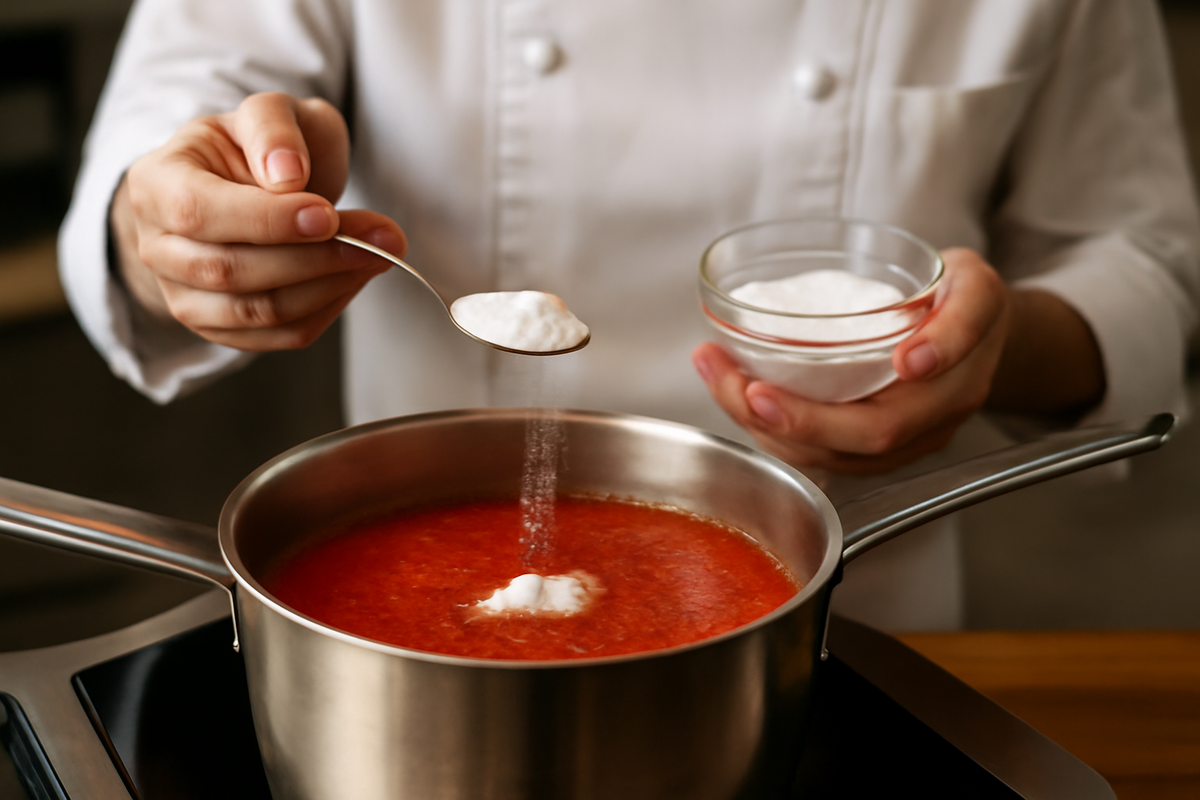
The sauce had been simmering for almost an hour when the chef did something that made everyone in the kitchen pause. With the steam rising in fragrant curls of garlic, basil, and slow-cooked tomatoes, he reached for a jar on the shelf—not sugar, not salt, but a little cardboard box with a familiar orange logo. He pinched a tiny amount between his fingers, no more than a dusting, and flicked it into the pot. The bubbling quieted for a moment, foam rising and then settling like a calm exhale. “For the heartburn,” he said with a shrug, as if he’d just explained the weather instead of rewriting the chemistry of dinner.
When Tomato Sauce Bites Back
Tomato sauce should feel like a hug. Warm, tangy, comforting. But for many people, it behaves more like a punch in the chest—burning esophagus, tight throat, that heavy feeling of regret that arrives about ten minutes after the last forkful of spaghetti. You push your plate away and think, not again. It’s not the garlic alone, not the oil, not really the pasta. It’s the tomatoes.
Tomatoes are naturally acidic, sitting somewhere between 4.2 and 4.9 on the pH scale. That tang you love on your tongue is the same sharpness that can irritate the lining of your esophagus, especially if you’re prone to heartburn or acid reflux. Heat concentrates that acidity. Reduce a tomato sauce too far, and you’re not just thickening flavor—you’re turning up the volume on the acid.
In the quiet choreography of a professional kitchen, chefs learn to read the little nonverbal signals that food sends. A sauce that smells a little too sharp, that leaves a bit too much sting at the back of the throat, that’s the one that will come back to haunt the diner’s chest later. So, in some kitchens, a quiet trick lives in the shadows of bigger, flashier techniques: a pinch of baking soda.
The Tiny Pinch That Changes Everything
Sodium bicarbonate—baking soda—doesn’t look like much. A soft white powder, flavorless until it meets acid, often relegated to the back of the pantry or the corner of the fridge, silently absorbing odors. Yet in the right moment, in the right sauce, it becomes a kind of kitchen alchemy.
When it hits tomato sauce, something very simple and very important happens: a chemical reaction. Baking soda is a base. Tomato sauce is an acid. Put them together and they neutralize each other, releasing carbon dioxide. That’s the soft hiss and bloom of tiny bubbles you might notice if you’re watching closely. The surface of the sauce quivers, a light foam forms, and a gentle sigh of gas escapes into the air. Then everything settles again, as if the sauce has taken a long, slow breath.
This isn’t magic. It’s pH in action. By adding baking soda, the chef nudges the sauce away from the more aggressive, higher-acid range closer to neutral. Not all the way—this isn’t about turning tomatoes into something bland and flat—but just enough to take off the sting. The sauce still tastes like tomatoes, still has brightness and body, but it loses the harsh edge that often leads to discomfort later.
The Sensation of Softer Acidity
If you’ve ever tasted two different tomato sauces side by side—one left as-is, the other touched gently with baking soda—you’ll feel the difference before you can name it. One might hit your tongue with a sharp, almost metallic snap. The other still tastes fresh and lively, but the acidity sits deeper, rounder, like a warm glow instead of a spark.
Your throat notices, too. Instead of that faint scratch or afterburn, the softened sauce travels down more quietly. For people who deal with reflux, this subtle change can mean a big difference in how they feel after a meal. It won’t cure a medical condition, but it can make dinner feel less like a gamble.
The Science Behind the Soothing
Imagine the pH scale as a long hallway. At one end, extreme acid. At the other, extreme base. Tomatos walk in wearing a bright red jacket somewhere toward the acidic side. Baking soda steps in from the other direction, a calm white-shirted opposite. When they meet in the middle, they take off some of that intensity. The hallway gets quieter.
Acidic foods—like tomatoes, citrus, vinegar—can relax the lower esophageal sphincter for some people, the small muscular gate that’s supposed to keep stomach contents where they belong. When that gate loosens, acid from the stomach can creep upward, leading to the familiar burn. Reducing the acidity of the food you eat may help lessen that trigger, especially if your system is already sensitive.
Baking soda reacts with the acids in the sauce—like citric acid and malic acid—to form salts and water. That chemical softening means that what finally lands in your stomach isn’t quite as aggressive. Again, this isn’t a medical cure or a universal fix, but it’s a clever bit of everyday chemistry that many chefs secretly rely on to make their tomato-based dishes feel more gentle.
A Quick Look at What’s Happening in the Pot
| Element | Before Baking Soda | After a Pinch of Baking Soda |
|---|---|---|
| Acidity (pH) | Higher acidity, sharper bite | Slightly neutralized, less harsh |
| Flavor | Very tangy, sometimes sour | Rounder, smoother, still bright |
| Mouthfeel | Can feel sharp on tongue and throat | Gentler, softer on throat |
| Reaction | Acids left fully active | Acids partially neutralized, CO₂ released |
That little moment of bubbling and foaming you see on the surface of the sauce? That’s the visible trace of the reaction: gas escaping, acid softening, chemistry doing its quiet work while the kitchen hums around it.
Why Chefs Choose Baking Soda Over Sugar
For generations, home cooks tried to tame tomato acidity with something far more familiar: sugar. A spoonful here, a sprinkle there, meant to “cut the acid” or “balance the flavor.” And yes, sugar can make a sauce easier to love—but not because it changes the chemistry of acidity. It doesn’t. Sugar masks; it doesn’t neutralize.
The acid is still present in full force. Your tongue just gets distracted by sweetness, the way a loud room feels less overwhelming if you’re focused on one conversation. But your stomach, and especially your esophagus, still meet the same acidity once you swallow. For people who struggle with heartburn, that can mean the difference between a meal that tastes gentle and one that actually feels gentle.
Flavor vs. Feeling
Chefs who reach for baking soda are often thinking beyond taste. They’re thinking about how food feels—on the tongue, in the throat, later in the chest. If they can soften the sauce chemically, then they don’t have to drown it in sugar to make it palatable. The true tomato flavor shines through more clearly: earthy, sun-warmed, slightly sweet on its own.
Many cooks actually combine both approaches, though in cautious, thoughtful ways. They might add a tiny pinch of baking soda for the acid, and then a whisper of sugar just to round the edges of bitterness. Used correctly, the sauce doesn’t taste “flat” or “weird.” It simply feels like the tomatoes have ripened a little more, like you picked them at that perfect moment of balance instead of a day too early.
This is where craft truly shows. Too much baking soda, and the sauce shifts in a different, less pleasant direction—an odd soapy or metallic note can creep in. But just enough, barely measurable, is often the difference between a sauce that bites back and one that invites another bite.
How to Use Baking Soda in Your Own Sauce
Picture this: a pot on your stove, the soft tick of bubbles at the edges, the slow swirl of crushed tomatoes, garlic, onion, olive oil, a leaf of basil wilting into the steam. You taste it. Tangy. Maybe a bit too tangy if you know tomato dishes usually leave you reaching for antacids later.
This is the moment to reach for the box.
Not a spoonful. Not even half a teaspoon. Start with a pinch—about 1/8 teaspoon for an entire pot of sauce, perhaps 4 cups. Sprinkle it in gently, then watch. The surface will react, a soft foam lifting like a curtain, then slowly dissolving back into the red. Stir. Wait a minute. Taste again.
Has it softened enough? If not, add another tiny pinch. You’re not trying to erase the tomato’s character, just smooth its temper. Many chefs never measure at all; they go by sound, sight, and taste. The moment when the sauce feels like it’s “settled” is when they stop.
A Simple Guideline You Can Follow
For a standard home-style tomato sauce:
- Use 1/8 teaspoon baking soda per 4 cups (about 1 liter) of sauce to start.
- Add it after the sauce has simmered and reduced a bit; the flavors are more concentrated then.
- Stir well and let it cook for 3–5 minutes after adding.
- Taste before and after. Notice the difference in sharpness and in how your throat feels when you swallow.
If you go too far and the sauce starts to taste flat, you can bring back a little vibrancy with a splash of wine, a touch of vinegar, or a very small amount of sugar. But most of the time, you’ll find that the sauce simply feels more mature, like it’s had time to think about what kind of flavor it wants to be.
Beyond the Pot: How It Feels After the Meal
The true test doesn’t happen at the stove. It happens on the couch, or in bed, when the plates are washed and the lights are low. This is when your body reports back on whether dinner was a delight or a mistake.
For many people who usually avoid tomato-based dishes, a sauce softened with baking soda can feel remarkably different afterward. The fire in the chest might be dimmer, or not there at all. The bitter taste that sometimes creeps up the back of the throat may not show up. You still feel pleasantly full, maybe sleepy, but not like there’s a tiny dragon living just under your sternum.
That said, heartburn is complicated. It’s not just about what you eat, but how, when, and what your body is already dealing with. Fatty foods, big portions, lying down too soon, coffee, alcohol—they all play a part. Baking soda in sauce isn’t a shield against all that. It’s simply one lever you can pull, one quiet adjustment you can make that may tip the balance toward comfort.
Talk to cooks who’ve adopted this habit and they tell similar stories: “My partner can finally eat my marinara again.” “I can have pizza night without bracing for the burn.” “My grandmother always did this, but never explained why—it just worked.” Sometimes wisdom lives in the fingertips long before the science catches up to explain it.
When Not to Lean on Baking Soda Alone
There’s a temptation, once you discover how powerfully baking soda can soothe an acidic sauce, to see it as the hero of every dish. Sprinkle a little here, a little there, and maybe you’ll never feel heartburn again. But the kitchen rarely rewards one-note solutions.
Tomatoes are only one piece of the reflux puzzle. Oil-heavy sauces, rich meat toppings, late-night eating, and overeating in general can all overwhelm even the best-behaved tomatoes. If you’re regularly battling heartburn, softening tomato sauce is more like smoothing one rough stone in a whole gravel path. It helps, but it’s not the whole fix.
It’s also worth remembering that baking soda is high in sodium. A pinch in a pot won’t wreck your day, but if you’re watching your salt or dealing with blood pressure issues, you don’t want to start using it extravagantly or as a daily antacid without medical advice.
Doctors sometimes recommend occasional baking soda in water as a quick neutralizer for stomach acid, but that’s a short-term fix, not a lifestyle. In the kitchen, think of baking soda the way a painter thinks of white: useful for softening, balancing, and adjusting, but never meant to cover the whole canvas.
Bringing It All Together
Once you notice the pinch-of-baking-soda trick, you start to see it everywhere—in old handwritten recipes, in quiet side notes from seasoned cooks, in the slight foam that rises on a restaurant’s sauce if you’re lucky enough to glimpse the stove. It’s not glamorous. It doesn’t carry the romance of heirloom tomatoes or hand-torn basil. But it carries something else: care.
Care for how food tastes, yes, but also for how it feels to eat it. For how you sleep that night. For whether you’ll think, “Let’s make that again,” instead of, “It wasn’t worth the burn.” In a world where so much cooking advice is loud and showy, this trick lives in the quiet spaces, in the moment just before the lid goes back on the pot.
The next time you stand over a simmering sauce, spoon in hand, steam curling around your face, listen to what your tongue and your body are telling you. Taste the brightness. Notice the edge. And if you know that edge has turned on you before, reach for that small box, take the tiniest pinch, and let chemistry meet comfort in the swirl of your wooden spoon.
Frequently Asked Questions
Does baking soda completely remove acidity from tomato sauce?
No. A small pinch of baking soda only partially neutralizes the acid. The goal is not to make the sauce neutral, but to soften its sharpness so it’s easier on your throat and stomach while still tasting like tomatoes.
Will baking soda make my sauce taste weird?
Not if you use a tiny amount. Too much baking soda can give a bitter or soapy flavor. Start with about 1/8 teaspoon per 4 cups of sauce, let it cook a few minutes, and taste before adding more.
Is this safe for people with acid reflux or GERD?
For many people, slightly lowering the acidity of tomato sauce makes it more comfortable to eat. However, reflux and GERD are medical conditions with many triggers. This trick may help, but it is not a treatment or cure. If you have frequent heartburn, talk with a healthcare professional.
Can I just use sugar instead of baking soda?
Sugar can make the sauce taste less harsh, but it doesn’t neutralize the acid. Baking soda changes the chemistry; sugar changes the perception of flavor. Many cooks use a tiny bit of both, but for heartburn relief, baking soda plays the more important role.
When should I add baking soda to the sauce?
Add it after the sauce has been simmering and has reduced somewhat—usually near the end of cooking. That’s when the acidity is most concentrated, and you can best judge how much softening it needs by taste.
Does baking soda add a lot of sodium to my food?
A pinch in a pot of sauce adds some sodium, but usually not a large amount per serving. Still, if you’re on a strict low-sodium diet, use it sparingly and consider adjusting other salty ingredients like added salt or cheese.
Can I use this trick in other tomato-based dishes?
Yes. Chili, tomato soups, stews, and braises that rely heavily on tomatoes can all benefit from a tiny pinch of baking soda if they taste too sharp or tend to cause you heartburn. Add slowly, taste often, and let the dish guide you.

Hello, I’m Mathew, and I write articles about useful Home Tricks: simple solutions, saving time and useful for every day.