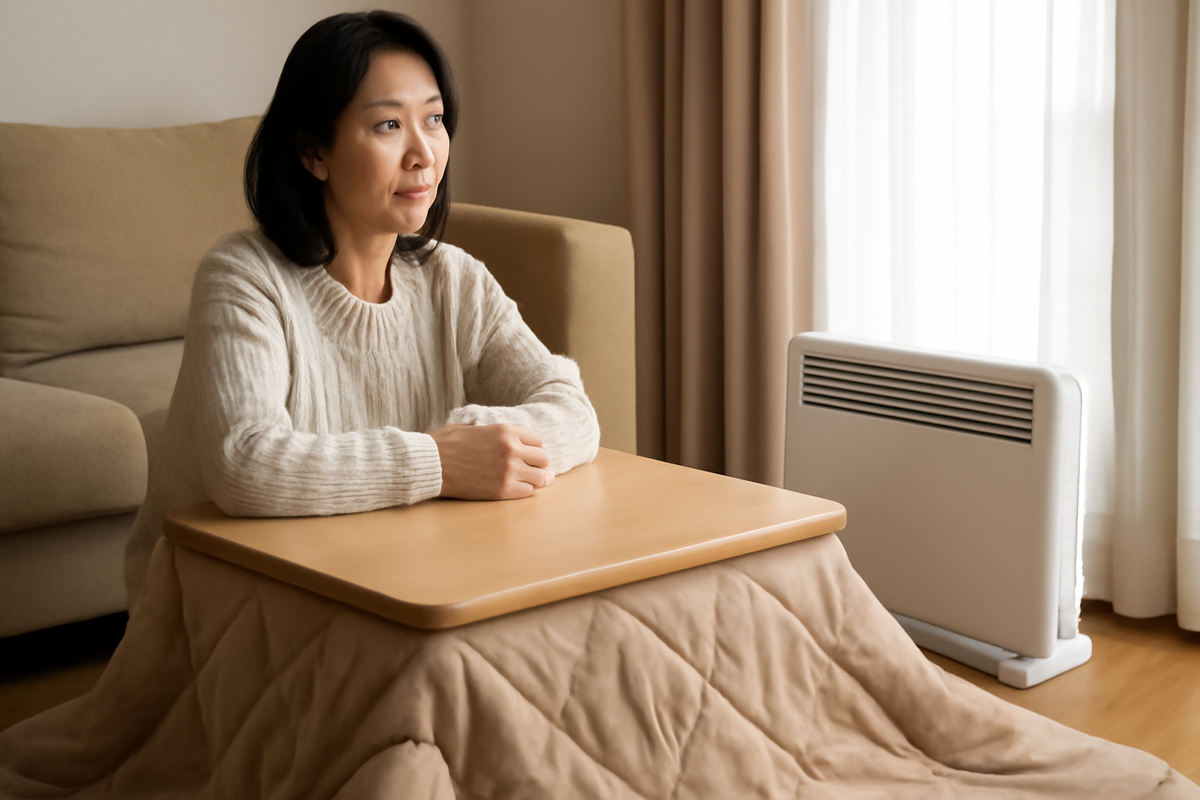
The first time I felt it, I was sitting on the floor of a small wooden house in rural Japan, my toes stiff and numb from the kind of winter cold that seeps straight through socks and good intentions. Outside, the wind pushed against the paper-thin shoji doors with a hollow, shuddering breath. Inside, you could see your own exhale hanging faintly in the air. Yet somehow, sitting around a low wooden table with a blanket draped to the floor, there was a pocket of warmth as rich and enveloping as a hug. I slid my legs under the blanket, and the world above the table blurred into chilly gray. Below it, though, was a secret summer: a soft radiant heat wrapping itself around my knees, my calves, my tired feet. I didn’t know the word for it yet, but that was the moment I fell in love with the Japanese winter heating trick that quietly beats thermostats at their own game.
The Cozy Secret Hiding Under the Table
The word is kotatsu, and if you’ve never heard of it, imagine this: a low table, not much higher than your knees, with a sturdy wooden top and a thick quilt sandwiched in between. Underneath, attached to the underside of the tabletop, lives a small electric heater. The whole thing looks unassuming enough, almost like an ordinary coffee table dressed for winter. But slip your legs underneath, and it becomes something else entirely—a personal microclimate of warmth in a room that might otherwise be barely heated.
That first winter, I was staying with a friend’s family in the countryside, in a house that seemed determined to leak every ounce of warmth it could. The walls were thin; the windows rattled in their frames. This was not the kind of sealed, double-glazed comfort that modern insulation promises. Central heating was nonexistent. There was no booming furnace in the basement, no vents puffing warm air into every room. Yet no one seemed particularly bothered. They shuffled in slippers, layered their clothing, and when evening arrived, they all gravitated to one place: the kotatsu.
It wasn’t just a piece of furniture; it was the heart of the house. Homework, snacks, television, long conversations, even the occasional nap—all of it happened around that table. Above the blanket, the air stayed cool enough to see a faint ghost of breath. Below it, the heater glowed with a gentle steadiness, and everyone tucked their legs into the shared warmth like hands into mittens. Instead of trying to heat every cubic meter of the house, they heated the space that mattered: where the people actually were.
Why Japan Doesn’t Crank Up the Whole House
To understand why the kotatsu is so beloved, it helps to understand winter in Japan. Not the postcard version of Kyoto dusted with snow, but the lived-in experience of older homes that predate the age of hyper-efficiency. Many traditional and even modern Japanese houses are what you might politely call “well ventilated.” Drafts nose their way through sliding doors. Floors are often made of wood, which can feel like ice under bare feet. Insulation exists, but it’s not always generous. Central heating never became the default in the way it did in North America or parts of Europe.
Instead, Japan grew around the idea of heating people, not spaces. For centuries, homes relied on small, localized heat sources: a charcoal brazier, an irori hearth, a gas or electric space heater, a hot bath at night, and of course, the kotatsu. The cultural norms evolved to match: more layers, more blankets, warm foods, warm drinks, and communal spaces centered around compact heat rather than blasting warm air through an entire building.
There’s something quietly radical about that approach. In a world where our first impulse is often to crank the thermostat until the whole house feels like early summer, the Japanese winter strategy looks almost subversive: accept that the room will be cool, and focus on making the human body deeply, luxuriously warm where it counts. The result? Lower energy use, lower bills, and a different relationship with winter itself—less a season to conquer, more a climate to negotiate with.
The Physics of Feeling Warm (Without Heating the Whole Room)
From an energy perspective, the kotatsu is a small masterpiece of common sense. A central heating system must work hard to raise the air temperature of an entire room—or an entire house—and then keep replacing that warmth as it escapes through walls, floors, ceilings, windows, and door cracks. The bigger the volume, the more energy required. You’re not just heating people; you’re heating empty corners, furniture, stairwells, even the dust in the air.
A kotatsu doesn’t bother with any of that. It creates a micro “bubble” of warmth where your body is in direct contact with it. The heater underneath the table warms the enclosed space formed by the quilt. Your legs and feet absorb much of that heat directly, while the blanket traps it, preventing it from dispersing into the rest of the room. Because it’s focused on a small, sheltered area rather than thousands of cubic feet of air, it can run at a much lower wattage than what most people are used to.
The difference shows up quickly in electricity use. While numbers vary by model, a typical kotatsu heater might consume roughly the same power as a mid-range space heater on low—sometimes less—yet deliver a far greater feeling of comfort because it concentrates warmth on your lower body, where cold tends to bite hardest. And it doesn’t need to run as aggressively or as continuously as a furnace trying to fight off the cold in every hallway and bedroom.
To get a clearer sense of how this translates into daily life, imagine a winter evening where your home is cool but not freezing—say, sweater weather indoors. You could crank the central heating up several degrees to feel thoroughly comfortable. Or you could keep the thermostat modestly low, pull your chair up to a kotatsu-style setup, and find that your torso and legs feel just as warm as they would in a much hotter room, while you burn noticeably less energy overall.
| Heating Approach | What It Heats | Typical Feel | Energy Behavior |
|---|---|---|---|
| Central Heating | Entire rooms or whole home | Even warmth, but costly for leaky spaces | High demand to maintain air temperature everywhere |
| Space Heater (Free-standing) | Localized area of the room | Warm nearby, cooler elsewhere | Moderate to high use, can run continuously |
| Kotatsu-Style Heating | Your legs, feet, and immediate seating zone | Very cozy below table, cool but tolerable above | Lower sustained use by heating a small, enclosed pocket |
How the Kotatsu Changes the Way Winter Feels
There’s a psychological magic at work too. Warm air from a furnace is invisible, anonymous—something humming in the background while you go about your business. A kotatsu demands participation. You have to move towards it, lift the blanket edge, slide your legs inside, arrange the fabric, feel the temperature shift. It’s an action, a ritual, a decision to step into warmth rather than having warmth chase you around the house.
Under the kotatsu, sensations sharpen. You notice the contrast between the coolness on your face and the gentle flush of heat rising through your legs. Tea tastes hotter, somehow more alive. The sound of the wind outside the window suddenly feels more distant, as if you’re tucked inside a small, radiant cave. Children nest there with books and toys. Grandparents nod off mid-conversation. Cats become permanent fixtures, melting into sleepy puddles under the blanket.
That intimacy has a side effect: it draws people together. In many Japanese homes, winter evenings naturally coalesce around the kotatsu, in the same way a campfire pulls a circle of bodies close in the dark. When everyone is sharing the same island of heat, phones get set aside more easily, conversations last a little longer, quiet companionship feels natural. Energy efficiency becomes not just a graph line on a bill, but a way of shaping how we inhabit our spaces—and who we share them with.
There’s also a subtle shift in expectations. Instead of aiming for “shirt-sleeve temperatures” in every corner, the kotatsu suggests a different goal: keep your core, your hands, and your feet deeply warm, and let the room itself stay gently cool. Put on a cardigan. Wrap a scarf around your neck. Accept that winter will always have a little edge to it—and that’s fine, as long as you have one profoundly cozy haven to retreat to.
Bringing the Japanese Trick into Your Own Home
Maybe you don’t live in a draughty wooden house in Hokkaido. Maybe you have decent insulation and a reliable heating system. Even so, the principle behind the kotatsu can quietly reshape how you use energy: don’t overheat the emptiness; lavish warmth on the place where your body actually rests.
If you’re able to get your hands on a real kotatsu table and quilt, that’s the most straightforward path. But you can also borrow the concept and improvise. A low, sturdy coffee table can be turned into a makeshift kotatsu-style nook with a few simple additions: a thick, fire-safe blanket or duvet draped between the tabletop and your legs; a compact, thermostatically controlled electric heater designed for enclosed or under-desk use; and, most importantly, a commitment to safety. The Japanese versions are engineered to vent properly and avoid overheating textiles; any DIY adaptation should be treated with the same caution you’d give to any space heater. Nothing should press directly against the heating element, cords should be clear, and the unit should be stable and certified for indoor use.
Beyond the furniture itself, you can layer in other small, Japanese-inspired strategies that support the same philosophy of focused warmth:
- Dress from the ground up. Warm socks, indoor slippers, and lined leggings or thermal tights create a base layer that makes a cooler room feel comfortable.
- Use lap blankets and shawls. A light blanket over your knees or shoulders turns moderate heat into deep comfort.
- Time your heat. Run your main heating system just enough to take the edge off the chill, then rely on your kotatsu-style station for sustained coziness.
- Strategically place rugs. A rug under your table area helps block cold seeping up from the floor, especially in older buildings.
- Lean on warm food and drinks. Hot tea, soup, and one-pot winter meals resonate especially well when you’re settled in your warm little island.
The first week you try it, the difference in comfort-to-energy ratio can be startling. You may find that you’re perfectly content with the thermostat set a few degrees lower than usual, as long as your legs are tucked into their private sanctuary of heat. Instead of pacing around trying to feel warm everywhere, you start building micro-habitats of coziness: a reading corner, a work nook, an evening gathering spot—all with targeted warmth, not blanket conditioning.
The Emotional Economy of Using Less
Energy bills are the blunt, obvious reason people start hunting for alternatives to whole-house heating, but there’s another layer to this Japanese trick: the way it reframes “using less” as an act of richness rather than sacrifice. A cooler room and a smaller heater could feel like austerity. Under a kotatsu, they feel like deliberate design.
You are no longer fighting the season; you’re rearranging your life to meet it with a kind of elegance. You’re spending more time in one particularly inviting zone instead of wandering distractedly from room to room. You’re paying attention to textures—the feel of a quilt between your fingers, the softness of a cushion under your knees, the velvety rise of heat along your shins. Winter becomes less about enduring the cold and more about crafting experiences of warmth that are bodily, social, and memorable.
There’s a small mental adjustment that comes with this: understanding that comfort doesn’t have to mean uniformity. It’s fine, even beautiful, for your home to have temperature gradients, like sunlight and shade in a forest. Cool hallways, a brisk-feeling kitchen, a sharp little gust each time the door opens—and then, in the center of it all, a pocket of glow where your body relaxes completely. That’s what a kotatsu offers: not climate control, but climate choreography.
In an age where we talk more and more about sustainability, it’s tempting to think that cutting back means giving things up—lowering the thermostat, wearing extra layers, bracing ourselves for discomfort. The Japanese winter trick turns that logic slightly on its head. Use less energy, yes, but concentrate it where it matters so much that your experience of warmth actually becomes more vivid, more satisfying, more human.
FAQs
Is a kotatsu really more energy-efficient than central heating?
In many situations, yes. A kotatsu heats a very small, enclosed area around your legs and lower body, so it can often run at a lower power level than it would take to heat an entire room. If you’re willing to keep the overall room temperature cooler and rely on the kotatsu for deep comfort, you can significantly reduce your total energy use.
Will I feel cold above the table if the room isn’t fully heated?
You may notice that your face and hands feel cooler than in a heavily heated room, but most people find that the strong warmth on their legs and core makes this contrast pleasant rather than uncomfortable. Wearing a light sweater or shawl usually makes the balance feel just right.
Can I recreate a kotatsu without buying one from Japan?
You can approximate the experience by using a low table, a thick blanket, and a safe, properly rated under-desk or small space heater. However, you must be very careful with safety: keep textiles away from any heating element, ensure good airflow, and never leave the setup unattended while running.
Is it comfortable to work or study at a kotatsu-style table?
Many people in Japan use kotatsu tables for homework, reading, and laptop work during winter. Because the table is low, you’ll usually be sitting on cushions or the floor rather than in a chair. If your back is sensitive, adding back support or a floor chair with a backrest can make longer sessions more comfortable.
Does it only make sense in old, poorly insulated houses?
No. Even in well-insulated homes, a kotatsu-style setup allows you to turn down your main heating and still feel very warm where you spend most of your time. The better your home’s insulation, the easier it is to maintain a slightly cooler baseline temperature while relying on localized warmth for extra comfort.
Is this heating style safe for children and pets?
Purpose-built kotatsu tables in Japan are designed with safety features, protective grilles, and controlled temperatures. Children and pets use them daily. For improvised versions, you’ll need to pay extra attention: choose devices with overheat protection, keep fabrics away from hot surfaces, supervise young children, and follow all manufacturer safety guidelines.
Can using a kotatsu really lower my heating bills noticeably?
Many households that adopt a kotatsu-style approach find they can lower their thermostat by several degrees during winter, especially in the evenings when everyone gathers in one place. Over a full season, that reduction can translate into a meaningful drop in energy consumption—and a quieter, more intentional way of experiencing winter warmth.

Hello, I’m Mathew, and I write articles about useful Home Tricks: simple solutions, saving time and useful for every day.